Collectible Foreign Longarms
(post-1898) Important information about ordering firearms from us!
If you see a firearm that you want, let us know and we will hold it for you. Firearms manufactured after 1898 can only be shipped to someone with a Federal Firearms License (FFL). If you have a Curio & Relic FFL, we can ship items considered by the BATF directly to you, as long as there are no state or local restrictions (California??). If you do not have a C&R FFL, then we can only ship guns made after 1898 to a FFL dealer in your area. The dealer will have you fill out a 4473 form ("yellow sheet") to conduct the required federal "Brady" instant background check, and any other paperwork required in your area before allowing you to take possession. FFL holders often charge a small fee for handling these transfers, as well as any state or federal fees for the background check. If you don't know of any FFL holders in your area, we may be able to help you find one willing to handle transfers. All firearms are sold as collectors items only. We warrant them to be as described, and make no claims as to fitness for use. Have them checked by a competent gunsmith prior to firing. We assume no liability for accidents or injuries resulting from firing or any other use of any firearm we sell. By ordering from this listing, you certify that you understand and agree to these terms. Notice- Because of bureaucratic requirements, we cannot sell cartridge firearms to customers outside the United States.
We are glad to answer any questions about the items we offer. We prefer you ask by e-mail so we will have time to pull items before answering, or check with the owner if they are consignment pieces. Click-here to e-mail us.If you don't have e-mailclick here for telephone contact information.
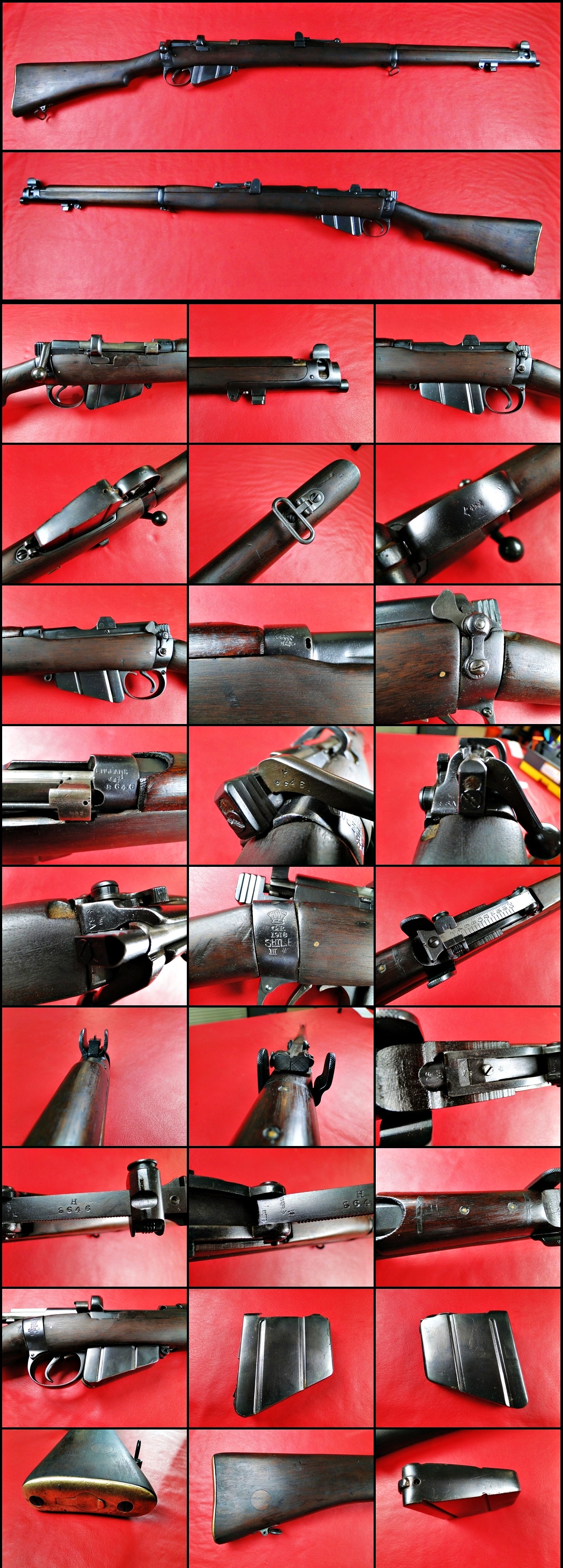
**HOLD** SMOF8071 - PEDDLED SCHEME STANDARD SMALL ARMS (S.S.A) LEE ENFIELD NO 1 MK III* SERIAL NUMBER H8646 CALIBER .303 BRITISH
The British Army adopted a magazine loaded bolt action rifle in 1888. The design came from a Scottish emigrant to the U.S., James Lee, and featured a 10 round top loading detachable magazine, with a bolt with rear locking lugs. It was modified after the Boer War based on the exposure to the Mauser rifle used by the Boers. The barrel was shortened, and a receiver bridge added for loading with stripper clips. The Lee-Enfield action saw continued development until 1907 when the MK III pattern was adopted. In 1916 the MK III* pattern was adopted to meet the ever growing needs of the British Army. This pattern streamlined the production process and deleted features deemed unnecessary, favoring a faster production rate over accessories of questionable value.
In 1914 S. J. Waring of Waring and & Gillow (a firm dedicated to the shaping and making of stocks) and a Mr. Peterson, a man of standing in the Birmingham gun business, founded the Standard Small Arms company. Standard Small Arms was founded to support the British war effort during the Great War by better utilizing skilled tradesmen in Birmingham. Initially spun up with the intent to provide nearly all components of the No. 1 rifle, it soon became evident that S.S.A was unable to accomplish this. The Ministry of Munitions stepped in a created what is referred to as the "peddled scheme", which created a pool of parts that smaller manufacturers would send their parts to, and the major manufacturers could draw from that pool as needed to ensure continuous production of rifles. S.S.A was tasked with making receivers with the charging bridge, bolt body, bolt head, and trigger guard. The Ministry of Munitions expected S.S.A to reach a production of 4,000 components a week. By 1917 S.S.A was deep in debt and had to be rescued by a loan from the government. By June of 1918 S.S.A was essentially seized by the government and renamed National Rifle Factory, with rifles being marked NRF instead of S.S.A. Production numbers for Standard Small Arms are not clear, but high estimates place production to below 50,000 rifles.
This rifle was produced by the Standard Small Arms Company in 1918 as part of the "peddled scheme" program. Numbers on the bayonet lug, receiver, bolt, barrel, and sight are matching. The bore is in exceptional shape and would rate near perfect. The finish is strong and would rate conservatively at 95% plus. No import mark is present, indicating that this rifle entered the United States before the mid 1960`s.
The Lee Enfield series of rifles is an interesting collecting niche with nearly endless varieties a collector could busy themselves acquiring. Peddled scheme rifles represent a fraction of a percent of the total production of the Lee Enfield family of rifles, and are a must have for any Enfield addict. $1350.00 (View Picture)
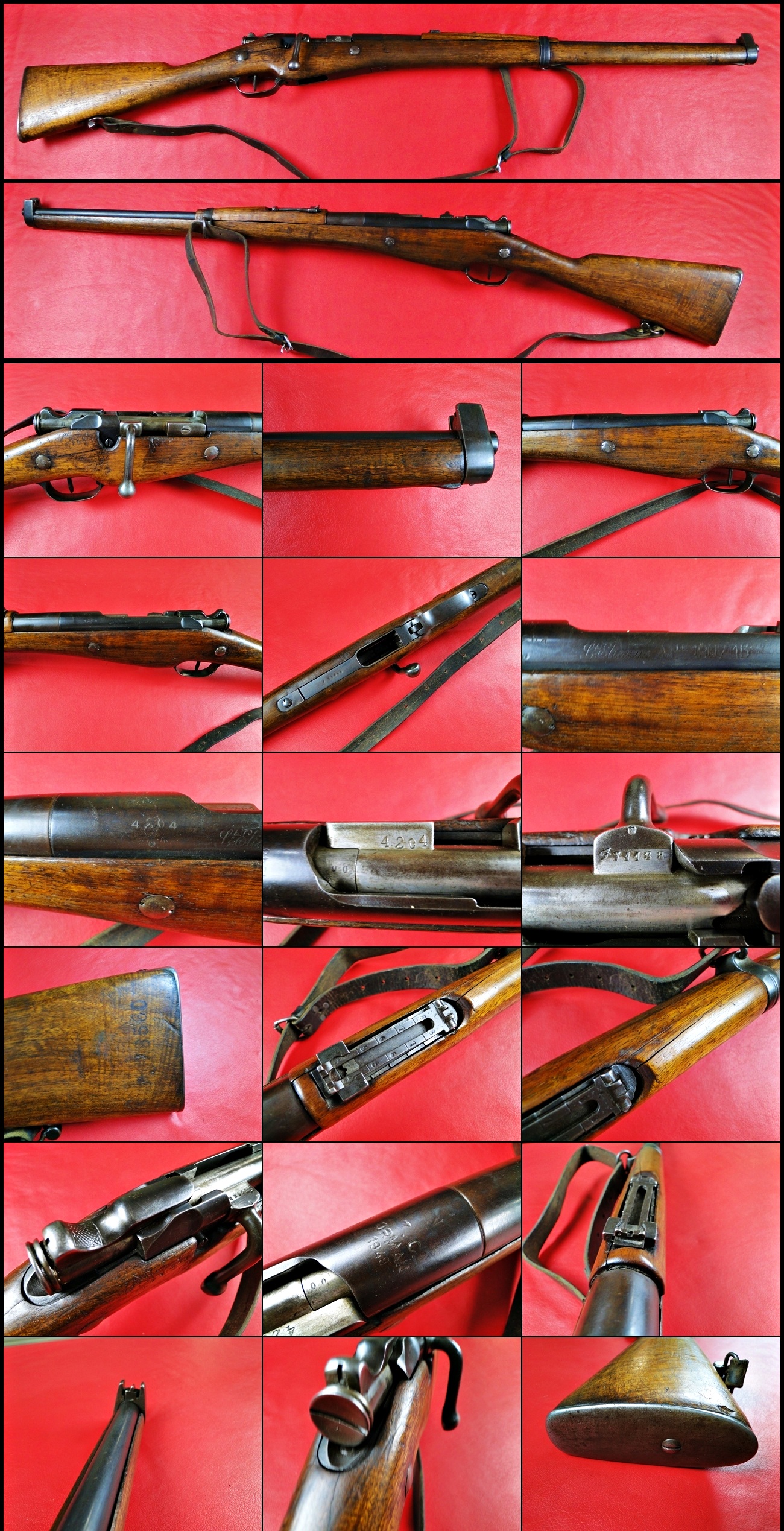
SMOF8073 - ST. ETIENNE BERTHIER FORESTRY CARBINE SERIAL NUMBER 4204 CALIBER 8MM LEBEL
In 1886 the French military adopted the first small arm capable of firing smokeless powder, the 1886 Lebel. The magazine system of the Lebel rifle made it less readily convertible to a shorter carbine style rifle, which was desired by cavalry or mounted troops and other auxiliary personnel. This need resulted in the adoption of the Berthier system in 1890.
The French army entered the Great War with the 1886 Lebel as the main line infantry rifle. In 1915 the French modified the colonial 1907 pattern Berthier by making the bayonet lug standard with the Lebel rifle and straightening the bolt handle, creating the 1907/15 pattern Berthier. The 1907/15 Berthier proved to be faster and cheaper to manufacture, and thus superseded the Lebel as the primary arm of the French during the Great War.
After collapsing under the grinding boot of the Nazi blitzkrieg in June of 1940, the National Assembly of the French Third Republic voted to give full dictatorial powers to Marshall Phillippe Petain, the hero of the Battle of Verdun, effectively ending the Third Republic and creating the collaborationist government of Vichy France. Nominally France continued to exist as a nation, but it effectively was under the strict over sight of Nazi Germany.
Turkey remained neutral during the greater part of the Second World War. Its strategic location was valuable to the Axis powers as it created an access point for desperately needed oil from the Middle East. The Axis powers tried to curry favor with Turkey by selling arms and other military supplies. In the late 40`s the Turks found a need to protect their walnut forests from illegal logging. Berthier rifles acquired from the French (likely at the behest of Nazi Germany) were found to be a desirable solution in that 8mm Lebel was difficult to source, and disarmament of a lone forest ranger by a criminal would not yield a very useful weapon.
This rifle is a 1907/15 Berthier that was produced at the St. Etienne arsenal. The French considered the part which was the "firearm" to be the barrel, and the serial number on the barrel is obstructed by a part later installed by Turkey, making the production date of this rifle impossible to determine. The Turks applied new serial numbers on the bolt and receiver, which are matching. No import mark is present. The bore is bright with strong rifling. The chamber has a faint "N" mark visible, indicating that this rifle was still in French hands in the early 30`s, and was fitted to safely fire Balle N ammunition. The Turks applied a "T.C. Orman 1948" stamp on the receiver, which translates to Turkish Republic Forestry 1948. This rifle has a carbine bolt rather than the straight handled bolt that is amateurishly bent which is usually encountered. There is a split in the hand guard on the left side and a crack is beginning to form in the stock near the receiver tang.
This rifle has an interesting history, having crossed several borders and serving different nations. Sling included! $650.00 (View Picture)
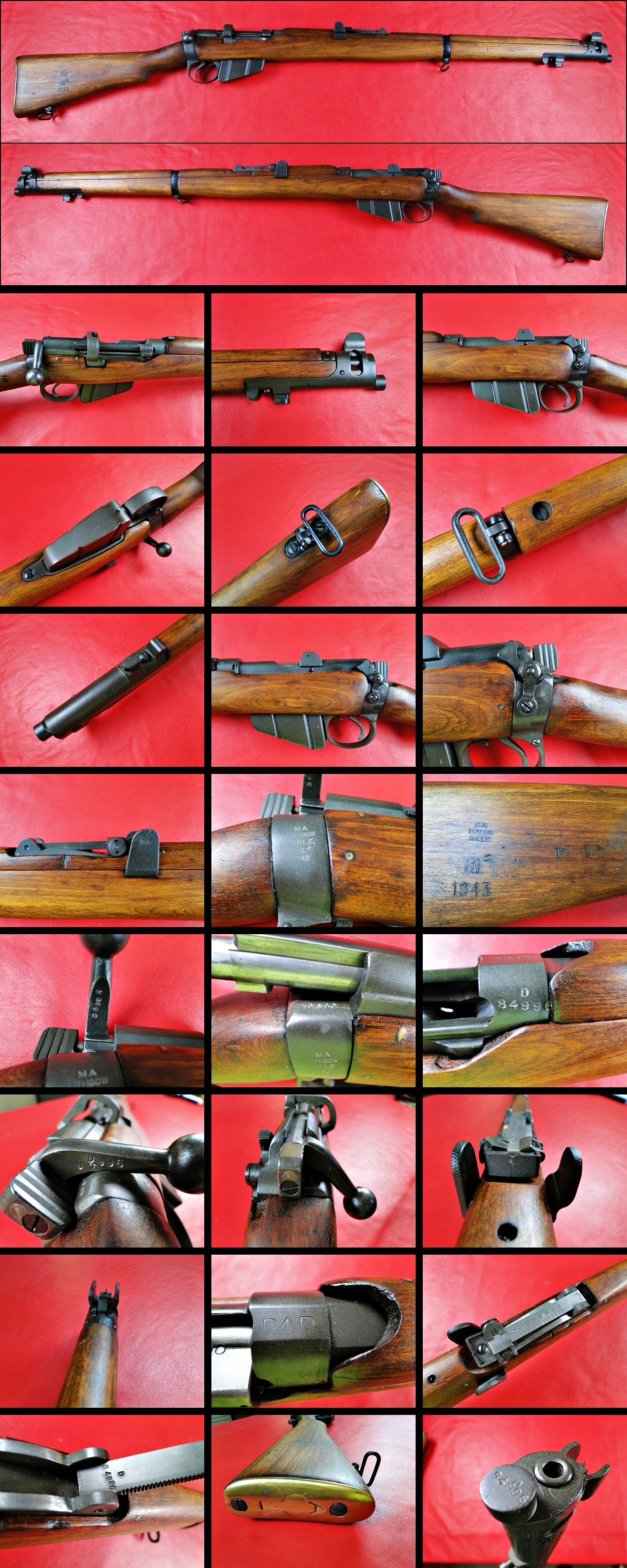
SMOF8077 - LITHGOW LEE ENFIELD NO 1 MK III* SERIAL NUMBER D84996 CALIBER .303 BRITISH
The British Army adopted a magazine loaded bolt action rifle in 1888. The design came from a Scottish emigrant to the U.S., James Lee, and featured a 10 round, top loading, detachable magazine, with a bolt with rear locking lugs. It was modified after the Boer War based on the exposure to the Mauser rifle used by the Boers. The barrel was shortened, and a receiver bridge added for loading with stripper clips. The Lee-Enfield action saw continued development until 1907 when the MK III pattern was adopted. Production of the MK III series commenced at Enfield, BSA, LSA, with Ishapore and Lithgow starting production at later dates.
The Small Arms Factory Lithgow was established in 1912 in the town of Lithgow, New South Wales. Having learned from shortages and supply issues during the Second Boer War, the Australian government decided a modicum of independence from the British in the realm of armaments would be desirable. Lithgow was determined to be a desirable location because it had a thriving industrial base which was already serviced by rail and road. At its inception, Lithgow was estimated to have a capacity of 20,000 rifles per year. By the conclusion of Lee Enfield production at Lithgow in 1945, it is estimated that approximately 640,000 rifles were made.
This rifle was manufactured at the Lithgow in 1942. All numbers are matched. Assembly numbers on the bolt and receiver are also matched. No import mark is present. Bore is bright and rifling is in excellent condition. Cartouches on the stock are strong. A Department of Defense marking is observed on the receiver knox form. Finish is in excellent condition and would rate around 95% plus. $850.00 (View Picture)
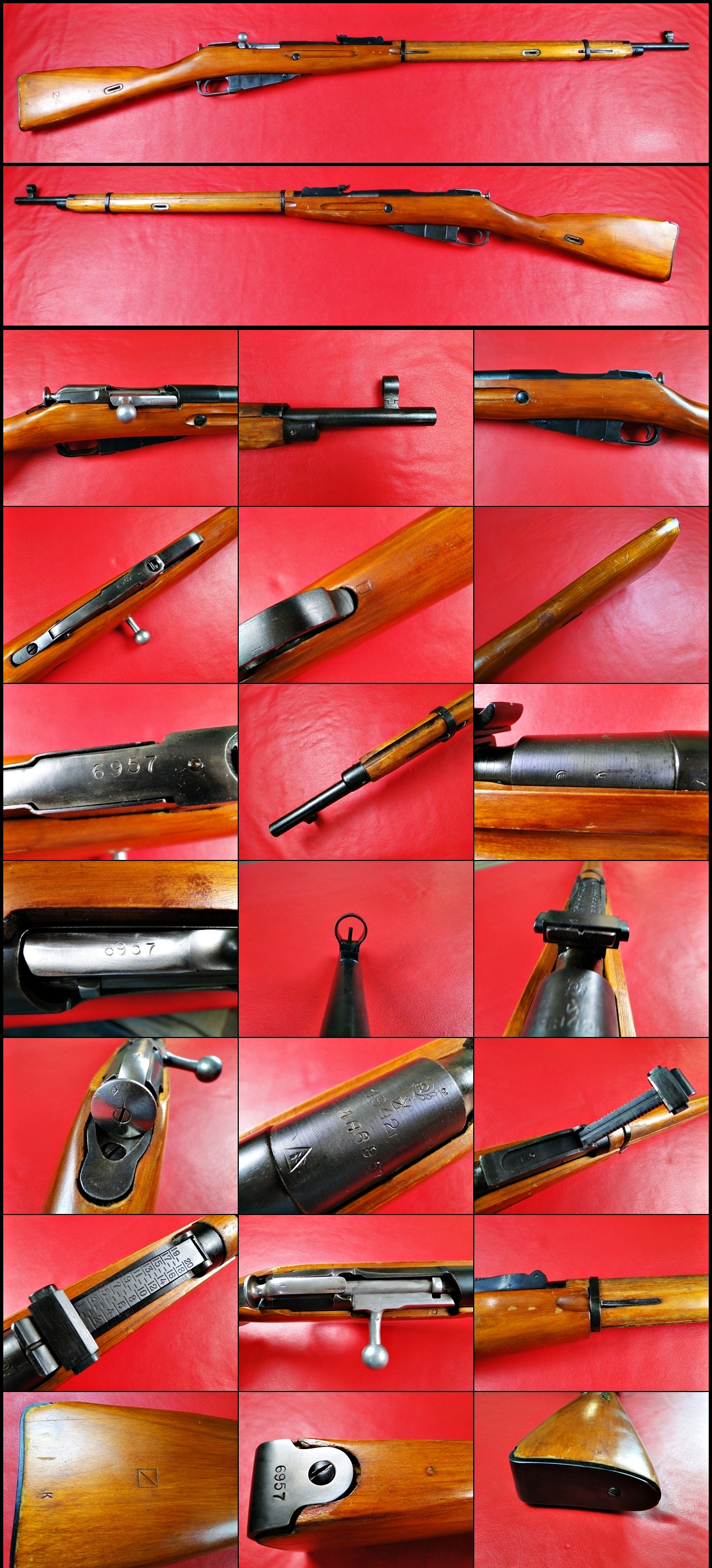
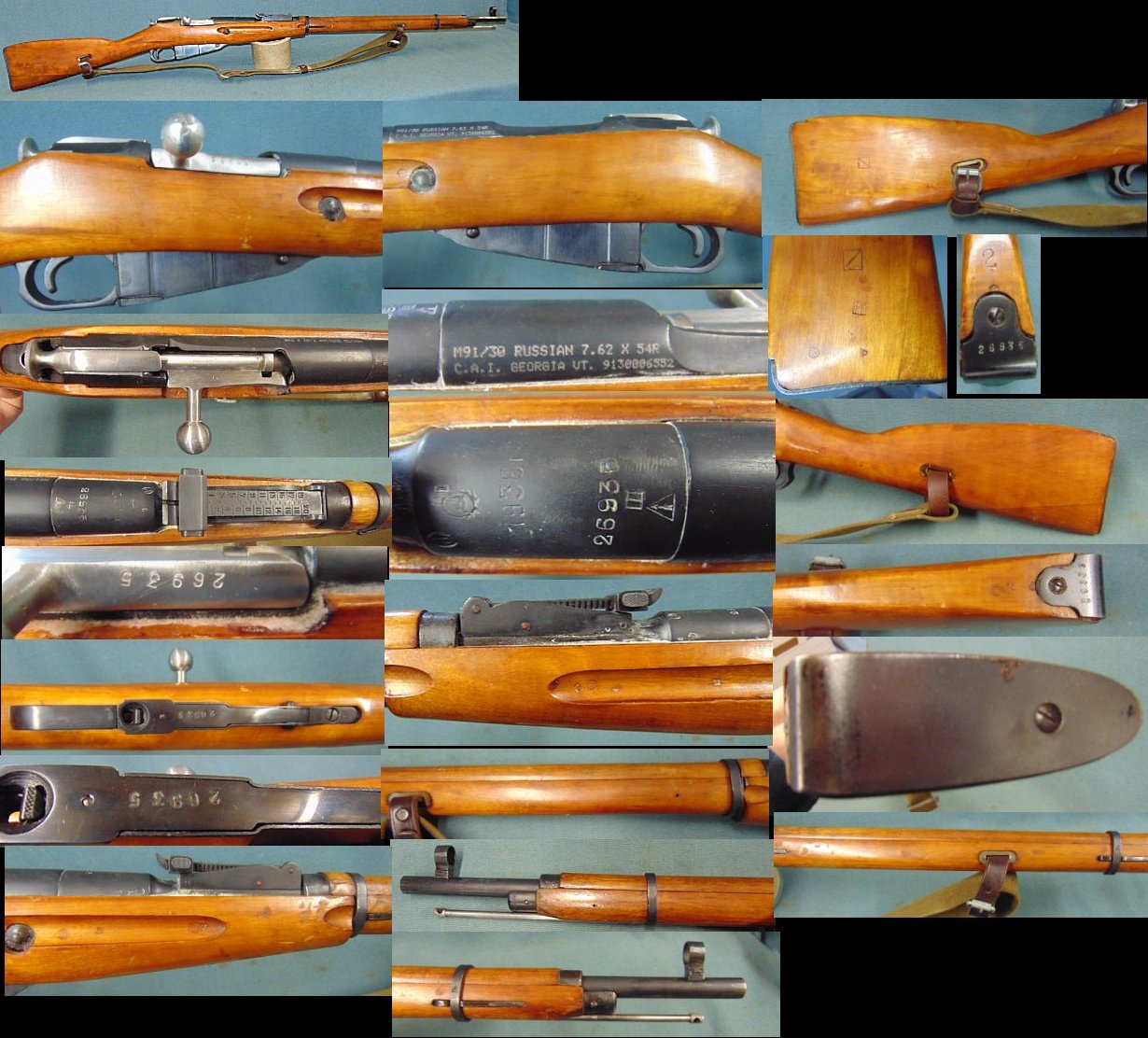
**SOLD** SMOF8084 - IZHEVSK MODEL 91/30 MOSIN NAGANT SERIAL NUMBER MA6957 CALIBER 7.62 X 54R
In 1891 Russia adopted a new rifle system primarily designed by Russian Sergei Mosin with design elements from Belgian Leon Nagant incorporated into the design. Initial production of the new 1891 rifle at the Russian arsenals of Izhevsk and Tula was slow, so contracts were granted to the French arsenal Chatellerault, and a third Russian arsenal at Sestroryetsk, in 1892. Further production of the 1891 rifle began at American firms Remington and New England Westinghouse in 1915 during the Great War.
Development of a shortened rifle began shortly after official adoption. In 1893 the Izhevsk arsenal began production of the dragoon model. This model included several small variations from the standard rifle. Most notably, the barrel was shortened approximately two inches. Intended for mounted infantry units, the shortened dragoon rifle was much less cumbersome than the standard 1891. In 1923 the Tula arsenal began production of the dragoon rifle. Both factories ceased production of this model in 1932.
In 1930 the Soviet government began an over haul program to update and repair rifles currently held in inventory. Old rear sights measured out in arshini were discarded in favor of new metric sights, the old front sight blade was traded for a globe and post style front sight, barrel lengths were standardized, and remnants of Imperial markings were scrubbed or defaced. Production of the hexagonal receiver was phased out in favor of a round receiver to expedite production and save materials. Modernization of the 1891 rifle was not immediate. Changes were implemented gradually, often as rifles in outdated configurations returned to arsenals for repair.
This rifle is 91/30 manufactured at Izhevsk in 1942. All numbers are matched. The bore is bright with strong rifling. No import mark is present. Finish would rate above 95%. $450.00 (View Picture)
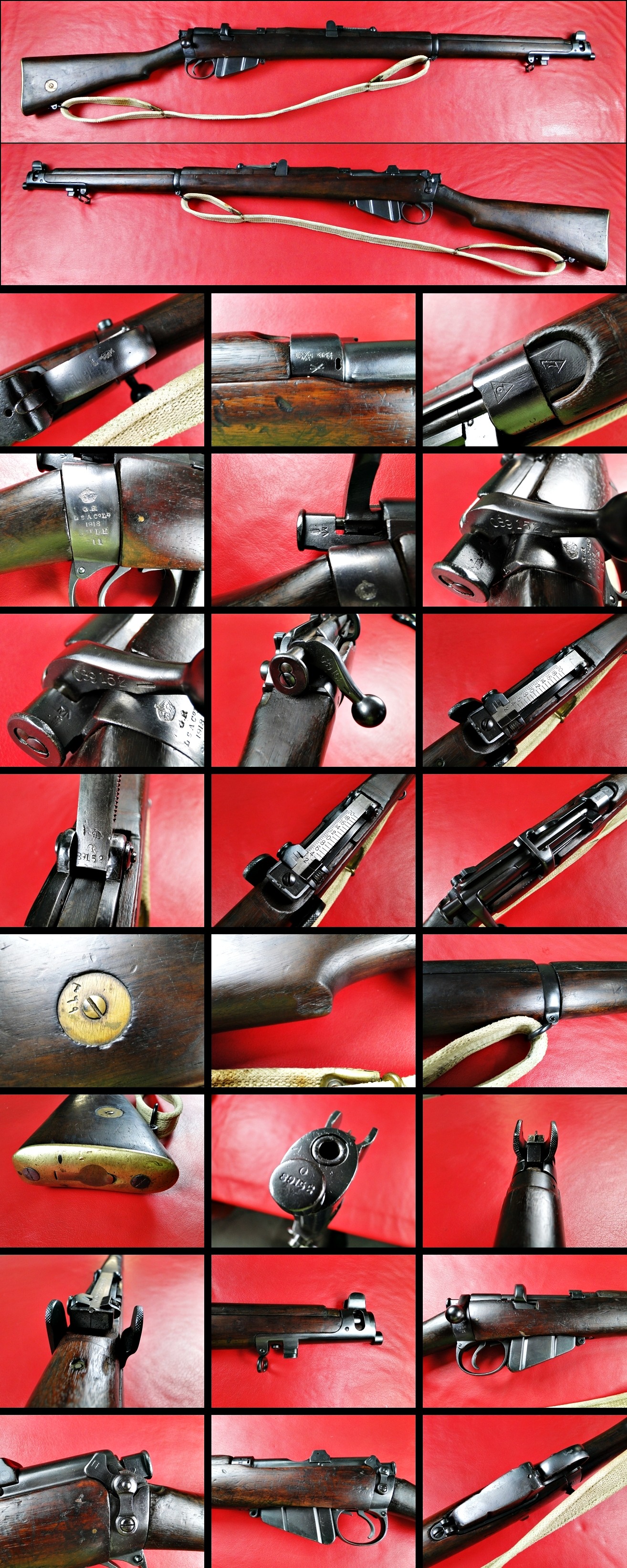
SMOF8070 - L.S.A LEE ENFIELD NO 1 MK III* SERIAL NUMBER O89152 CALIBER .303 BRITISH IRAQI MARKED
The British Army adopted a magazine loaded bolt action rifle in 1888. The design came from a Scottish emigrant to the U.S., James Lee, and featured a 10 round top loading detachable magazine, with a bolt with rear locking lugs. It was modified after the Boer War based on the exposure to the Mauser rifle used by the Boers. The barrel was shortened, and a receiver bridge added for loading with stripper clips. The Lee-Enfield action saw continued development until 1907 when the MK III pattern was adopted. In 1916 the MK III* pattern was adopted to meet the ever growing needs of the British Army. This pattern streamlined the production process and deleted features deemed unnecessary, favoring a faster production rate over accessories of questionable value.
The London Small Arms Company was founded in 1866 in the London Borough of Tower Hamlets by gunsmiths who were previously part of the London Armoury Company. LSA was founded to compete with Birmingham Small Arms and the Royal Small Arms Factory at Enfield. LSA sought to focus on production of higher quality arms, but found that it could not compete with BSA or RSAF, and was defunct by 1935. LSA is known to have made less than 350,000 of the estimated six million No. 1 rifles.
The treaties which concluded the Great War made the area of modern day Iraq a British protectorate until the 1920`s, when a revolt led to the creation of the Kingdom of Iraq under King Faisal I. Iraq continued to remain aligned with the British, who provided them substantial military aid during the inter war years.
This rifle was produced by the London Small Arms Company in 1918. After having served the British in the Great War, this rifle was then provided to the Kingdom of Iraq, as evidenced by the triangle marking on the knox form and barrel. Arabic numerals "369" are marked on the stock disc. Numbers on the bayonet lug, receiver, bolt, barrel, and sight are matching. The grip area of the butt stock had a piece of wood damaged long ago, but it is not very noticeable. The bore is in exceptional shape for its age (and environs of use). It is overall bright with strong rifling, but we did observe a dark spot about three inches from the muzzle which may or may not clean up. The finish is strong and would rate conservatively at 95% plus. No import mark is present, indicating that this rifle entered the United States before the mid 1960`s.
The Lee Enfield series of rifles is an interesting collecting niche with nearly endless varieties a collector could busy themselves acquiring. This rifle is an excellent example of the No. 1 series with an interesting provenance. Sling included! $950.00 (View Picture)
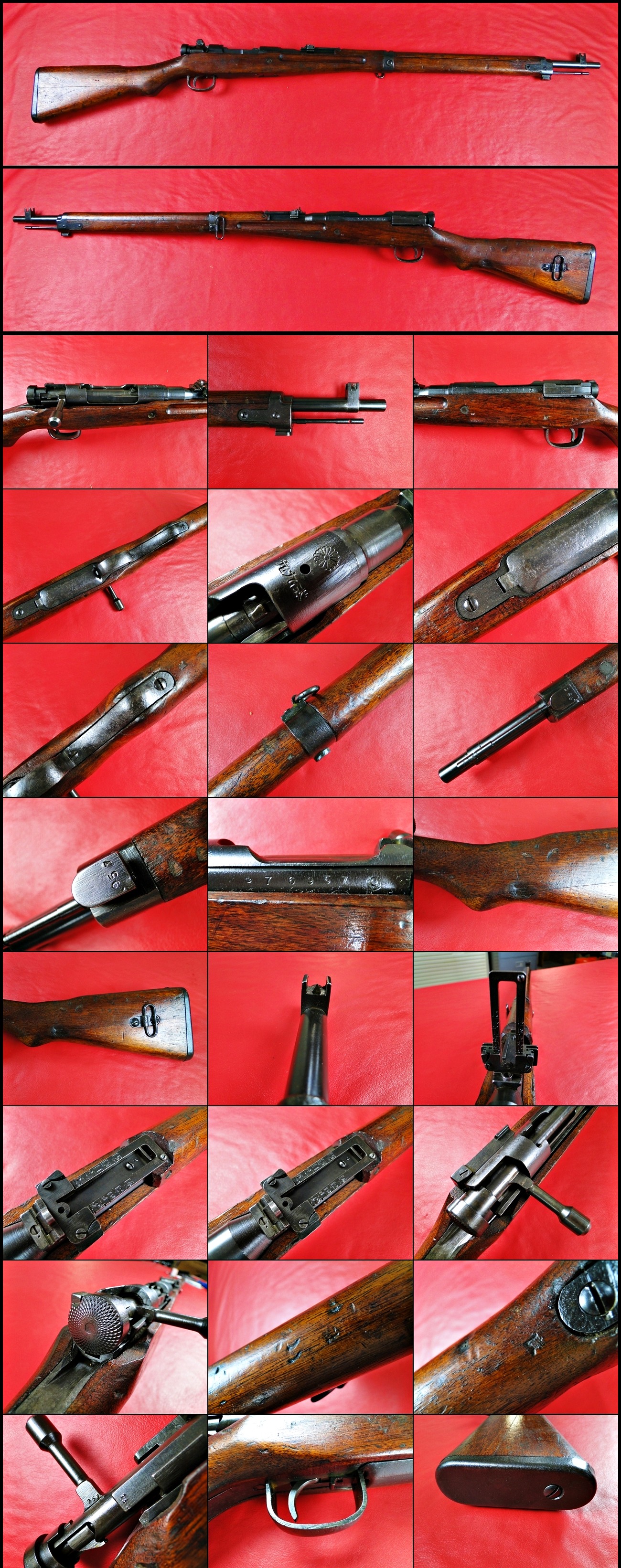
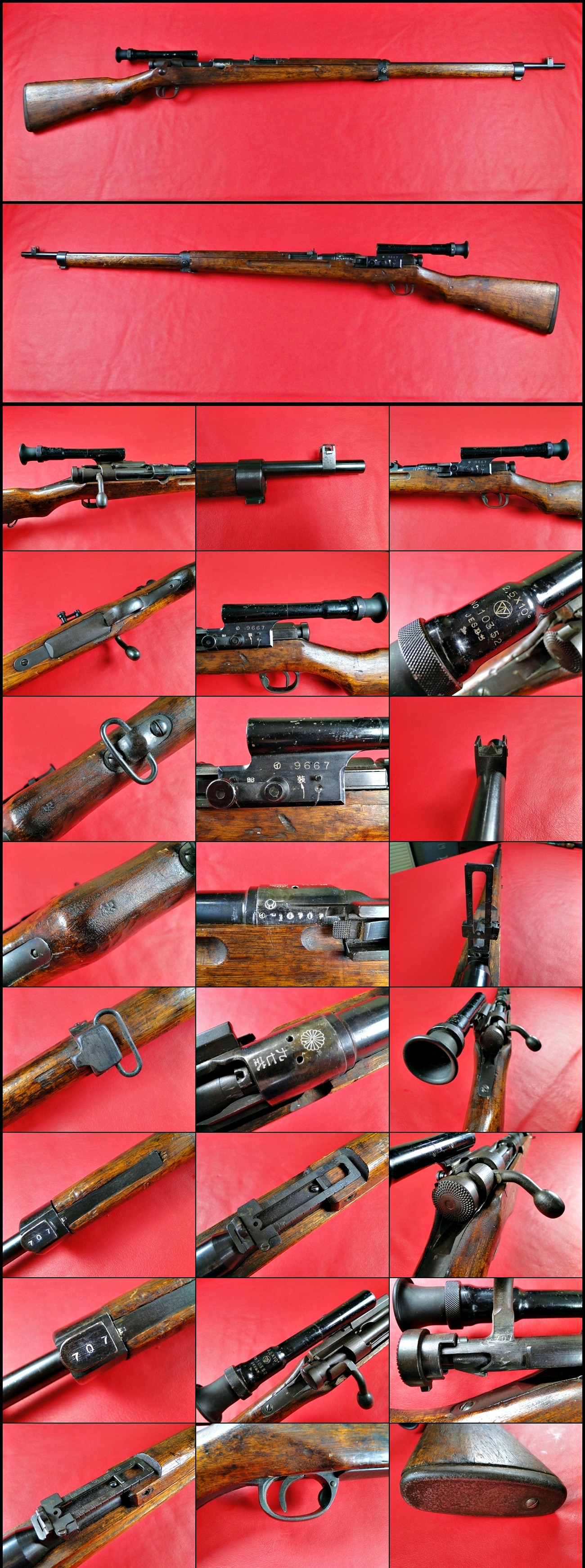
SMOF8035 - HANDSOME TYPE 99 JAPANESE WORLD WAR II RIFLE MADE AT THE NAGOYA ARSENAL 6TH SERIES. ALL MATCHING WITH INTACT MUM SERIAL NUMBER 76957.
Japan entered the industrial age with the single minded determination to create the industrial base equivalent to the one that had allow the European navies to force their country to open its people to trade. The Japanese quickly created a firearms industry unlike the Chinese who continued to purchase most of their small arms in Europe. By 1905 the Japanese Army had developed the strongest bolt action rifle in the world when they adopted the Type 38 in 6.5 mm. In 1939 the military decided to increase the caliber of their rifles to 7.7 mm, and introduced the Type 99 rifle. It used the basic action of Type 38, and was the first military rifle to have a chrome lined barrel. P.O. Ackley, the noted gunsmith compared the Japanese military bolt action rifles of World War II to those of Germany, England and the U.S. by seeing which ones could withstand the highest pressure loads. The Japanese bolt actions were still shooting when all the other actions, including the Mauser, had blown up.
The Imperial Japanese army had used their 6.5 mm Type 38 rifles in China. The units going to the Pacific island were generally armed with the Type 99 rifle. The Type 99 rifle was the ones most of our GI`s encountered in the actions that rolled back the Japanese Empire from Guadalcanal to Okinawa.
This rifle is all matching. The mum is intact. Original bluing is in excellent condition, and would rate at 98%+ present. Chrome lined bore is bright with good rifling. As the war progressed, the Japanese began to economize both their time and their resources, resulting in changes to the Type 99 rifle. This rifle was produced after economization measures had been implemented. The overall fit and finish of rifles in this series is comparable to early rifles; however changes to the bolt, barrel band, and rear sight are noted. Overall this is a superior example of a mid war Type 99. Short style cleaning rod included! $950.00 (View Picture)
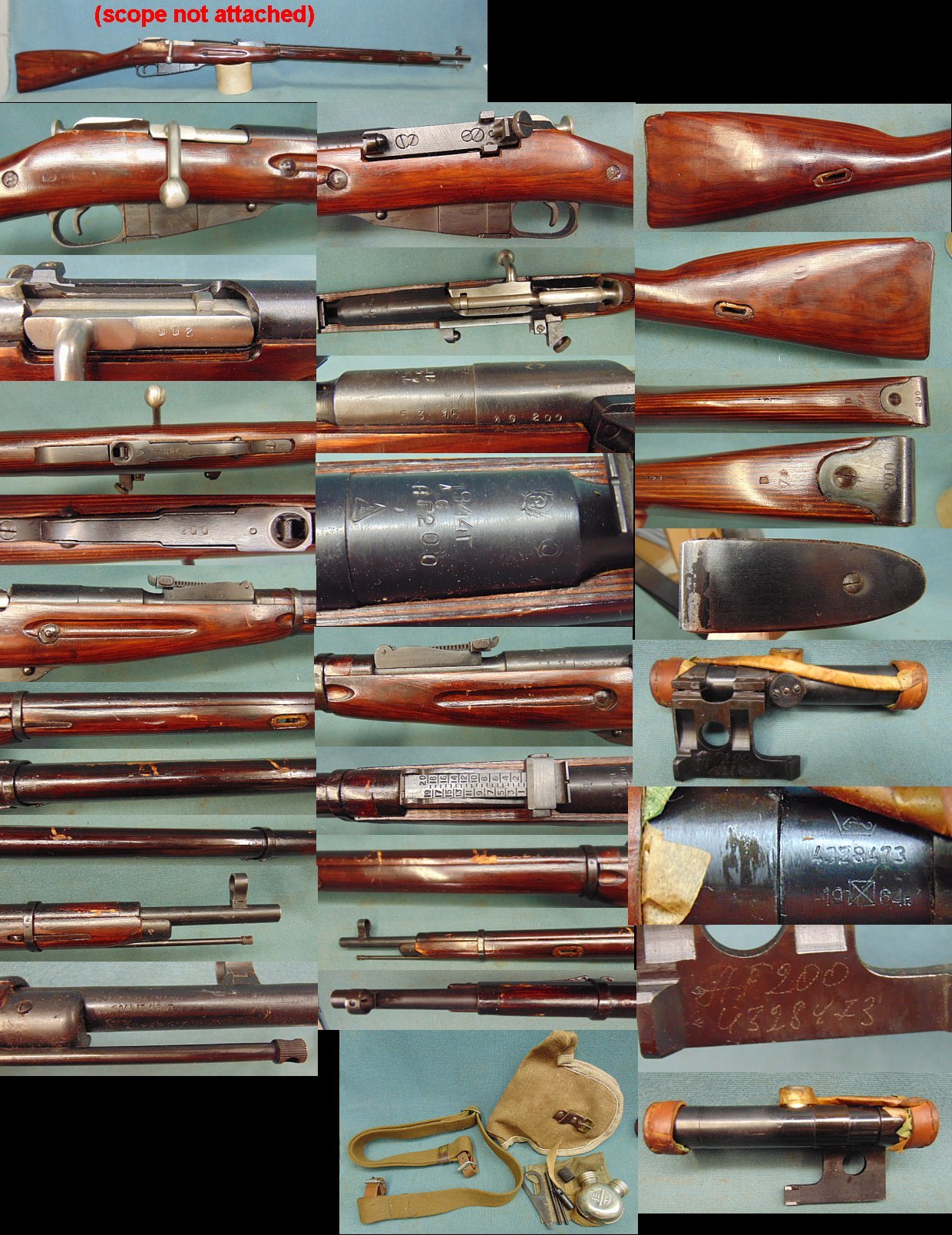
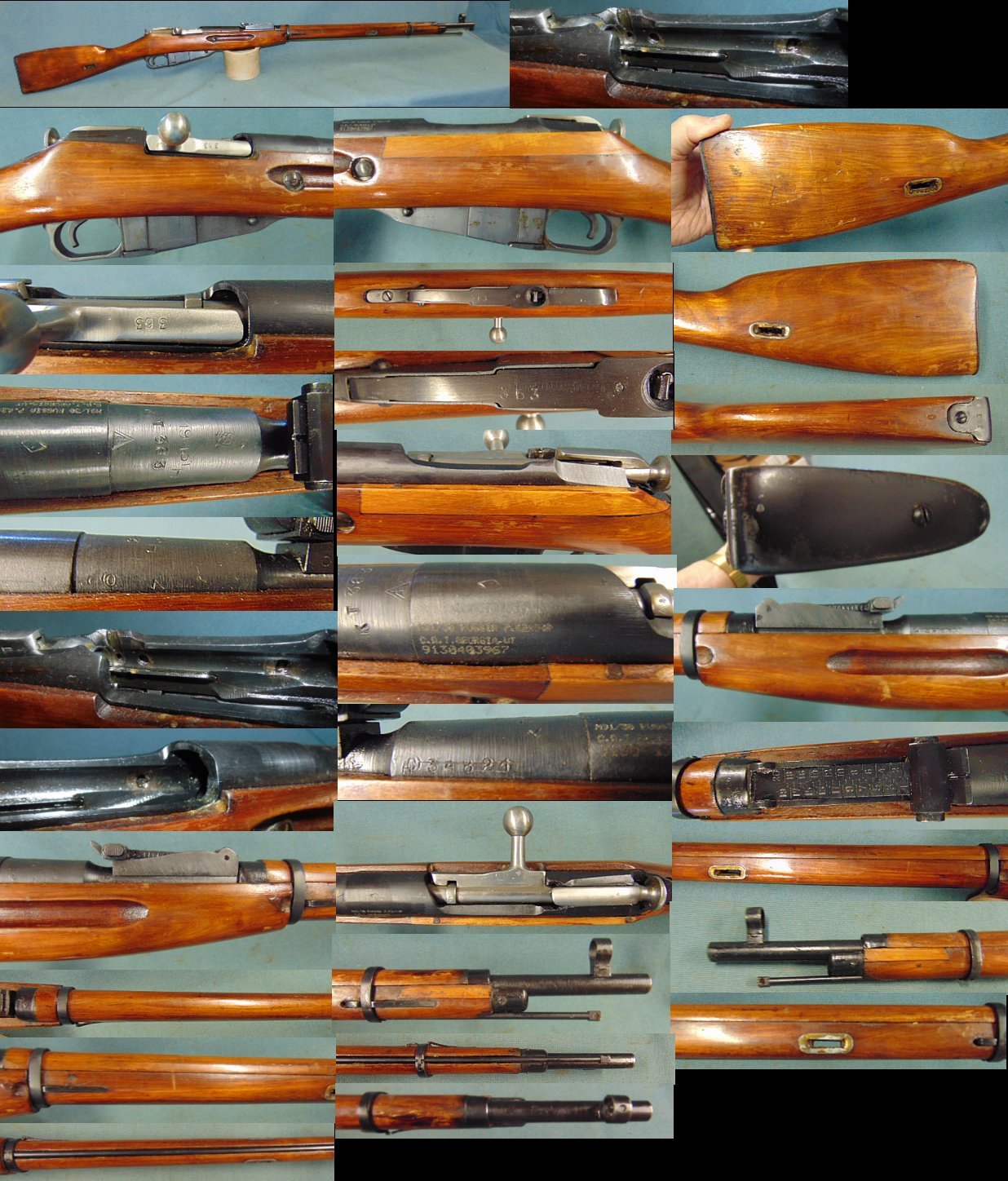
SMOF8005 - 2568 RUSSIAN MOSIN NAGANT ISHEVSK 1944 MODEL 91/30 PU SNIPER RIFLE -ARSENAL REFURBISHED TO AS NEW WITH LAMINATED STOCK- SUPERB!
Serial number AG200 made at Tula in 1944. (SERIAL NUMBER NOTE- Cyrillic pefix letters on the barrel shank "? ?" transliterate to English letters "AG" and the importer stamped the English equivalent above the Cyrillic symbols on the barrel shank and stamped the full serial number on the left side of the receiver per BATF regulations. The "CAI ST ALB VT" import mark is discreetly on the barrel near the muzzle.) This is a REAL Mosin Nagant PU sniper rifle, not one of the fakes cobbled together with junky rifles and cheap replica scopes in recent years. When Century Arms imported early batches of 7.62 x 54mmR Mosin Nagant sniper rifles, they had been refurbished, and this is one of those. The barrel has the "C in a circle" on the right side of the barrel shank indicating it met the standards for sniper rifle use. Izhevsk placed the scope number on left side of barrel 5315 for the original scope. (Tula did not do this.) During refurbishment, new scopes were matched to the rifles, and serial numbers of both the scope and the rifle were electric penciled on the left side of the scope mount. Numbers match on this rifle with "200" on bolt, buttplate and floorplate. The "refurbs" were reblued (but not polished first) and the stocks (old ones retained or replacements) were coated with a dark reddish- brown varnish or lacquer type finish. Scope mount is electric pencil numbered AG200 and scope number 4328473. The scope made in 1964, is correct WW2 type with oval head screws on the adjustment knobs and the reticule moves (not centered as with modern scopes), made for use in the refurbishment program. The repro scopes take several shortcuts including flat top screws in the knobs, and have fake WW2 dates. For a great discussion of Russian sniper rifles leading up to the PU type, see: https://www.wwiigermansniper.com/russian-snipers and for more on the PU see: https://www.gunboards.com/threads/izhevsk-91-30-sniper-list.53514/ for a census list of Izhvesk PU sniper rifles. There are a number of other sniper rifles listed in the Ishevsk 1944 AG serial number range. This is an excellent example of the WW2 Russian Mosin Nagant PU sniper as refurbished for war reserve stocks (I believe in Ukraine) and eventually sold off to Century as surplus in the late 1980s. This comes with web "dog collar" sling and coarse canvas scope cover, tools and oil bottle as shown in the photos. Scope still has the arsenal war reserve long term packing grease and wrapping around the adjusting knobs and under the leather scope caps. Excellent bore. A handful of places where the reddish-brown finish has scratched/flaked off the stock or handguard.mostly on the left side. This has been in John`s personal collection for 30+ years, and is unissued since overhaul and nearly impossible to upgrade. $1995.00 (View Picture)
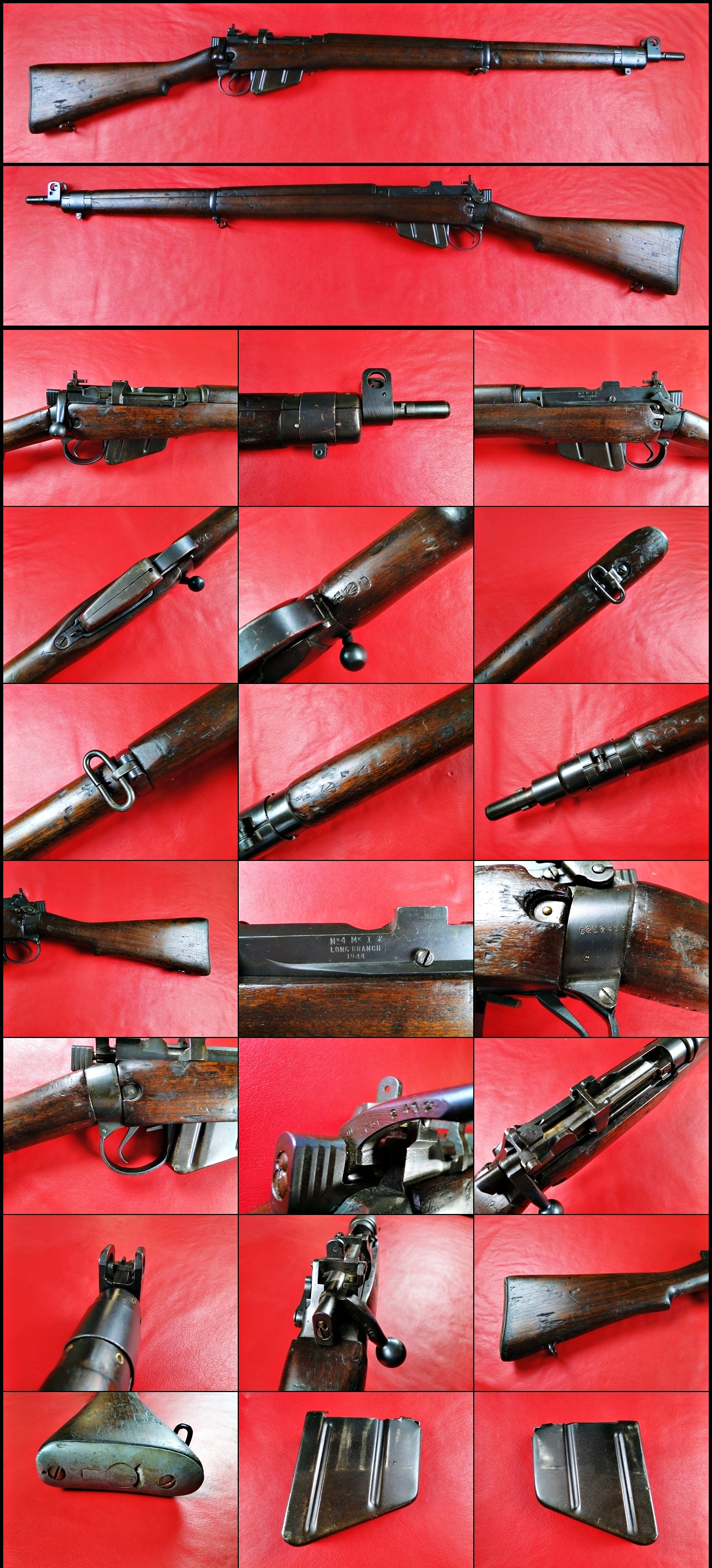
SMOF7989 - EXCELLENT NO. 4 MARK I* RIFLE MADE AT LONG BRANCH IN 1944 CALIBER 303 BRITISH. SERIAL NUMBER 62L2412
The British Army adopted a magazine loaded bolt action rifle in 1888. The design came from a Scottish emigrant to the U.S., James Lee, and featured a 10 round, top loading, detachable magazine, with a bolt with rear locking lugs. It was modified after the Boer War based on the exposure to the Mauser Boers. The barrel was shortened, and a receiver bridge added for loading with stripper clips. The Lee-Enfield action continued in British (and Commonwealth) service until 1955. It is considered one of the best designed battle rifles in the world. The ten round magazine gave it an advantage over all other bolt action rifles. The rear locking lugs were much less likely to foul with dirt, and the bolt could be operated more rapidly than the standard Mauser bolt.
In 1924 the British began development of the Number 1 Mark VI rifle. Major changes to the Number 1 Mark VI rifle include moving the rear sight to the receiver bridge, changing stock fitment and furniture, and the development of a fine adjustable micrometer rear sight.
In 1931 the British changed their rifle designation nomenclature. What was formerly the Short Magazine Lee Enfield Rifle Number 1 Mark VI became known as simply as the Rifle Number 4, which was adopted by the British near the end of 1939. Production of the Number 4 rifle would begin in 1941 at Maltby, followed by Fazakerly and B.S.A Shirley. North American firms Long Branch and Savage would also produce the Number 4 rifle.
The Long Branch arsenal was located in the Canadian province of Southern Ontario on lands owned by the Canadian government. Formerly a rifle range, military use was expanded during the First World War. In 1940 the construction of a factory was authorized, and Small Arms Limited was formed to operate the facility. Production of small arms began in 1941. Long Branch continued to produce and refurbish small arms until 1976, when the factory was closed.
This rifle was produced at the Long Branch arsenal in 1944. All numbers are matching. All small parts have the joined ?LB? mark, indicating production at Long Branch. The bore is bright and has strong rifling. Finish is excellent and would rate about 95%. The stock shows signs of typical use. Two Canadian broad arrow markings are observed on the stock, one at the wrist and the other near the front barrel band. No import mark.
This rifle is a handsome example of the No. 4 rifle, produced close to home in the Great White North. $750.00 (View Picture)
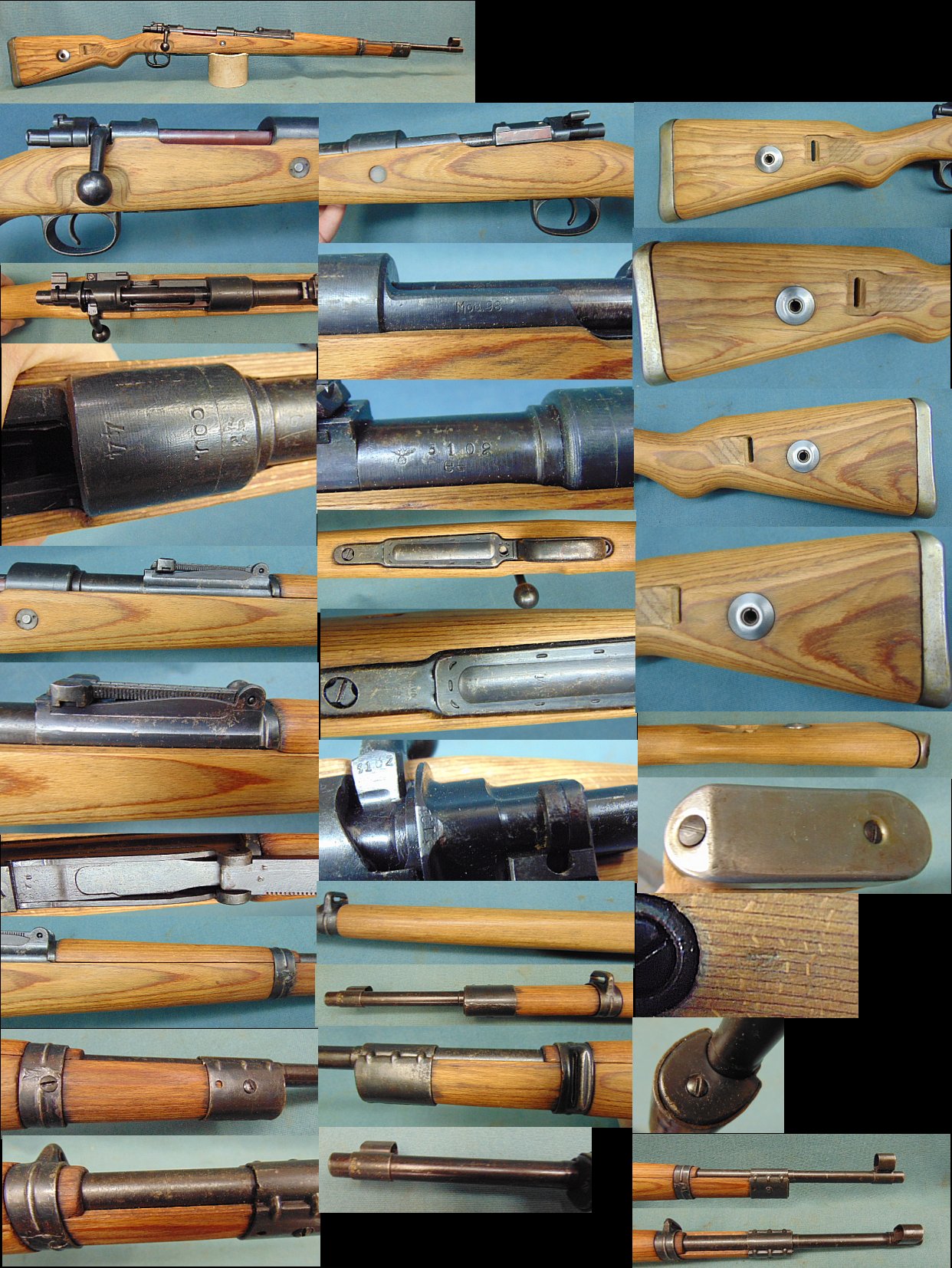
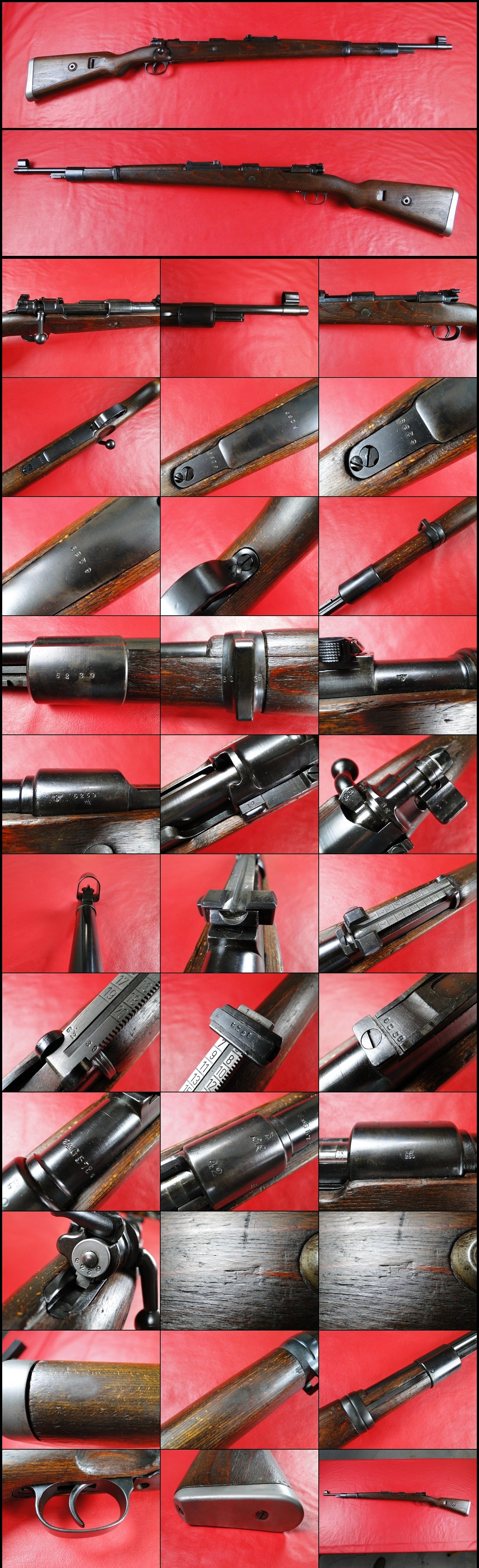
SMOF8033 - 2723 SCARCE LATE WW2 GERMAN KAR98K KRIEGS MODELL TRANSITION 8MM MAUSER RIFLE- "DOU 44"
Serial number 3102ee made at Waffenfabrik Brunn A.G. Werk II Povazska Bystrica also known as "Brunn II" which used maker code "dou" to distinguish it from the main Brunn factory (at Brno) known as Brunn I which used code "dot" and later "swp." At first glance this may look like any other of the millions of K98k Mauser rifles made for German use in WW2, but closer inspection shows that it is an important and scarce variant.
The excellent book, "Kreigsmodell," by Michael Steves and Bruce Karem is the definitive study on the late K98k rifles, and they also have two excellent volumes covering the earlier period as well. They get into extensive details on these rifles and this one Czechs out as correct in every detail. At the time in late 1944 when the ee-suffix series were being produced, the evolution to the Kreigsmodell was well under way at various Mauser factories. At Brunn II this was manifested in the immediately recognizable omission of the bayonet lug and cleaning rod, with the tip of the stock finished with a cap plate screwed to the tip. The serial number was placed on the barrel during this short period instead of the receiver, although they later reverted to marking the receivers. Bolt bodies, bolt sleeves and rear sights were serial numbered, but none of the other parts. The only Waffenamt marking is an eagle/WaA 80 on the top of the receiver ring. Unique to Brunn II the buttstocks had no serial numbers or waffenamts or Heer markings, only a cryptic single letter or number on the wrist near the trigger guard. The barrel bands are the stamped type, retained by screws salvaged from inventory of VZ24 parts on hand with two spanner holes in the head, modified to a straight slot, in lieu of a band spring. Even though the upper band had the hole for a band spring stud. While the screwed bands are typical Kreigsmodell features, Brunn II continued to use the bolt disassembly disc in the butt, which was later dropped in favor of a simple hole through the buttplate cup and stock. The trigger guard assembly is all stamped parts, not the fine quality milled parts originally used. Overall quality and fit and finish are still quite good late in 1944, but deteriorated steadily as Allied bombing continued to disrupt plant operations and the supply chain for parts from subcontractors. In some ways the emergence of the Kreigsmodell was analogous to the American introduction of the Model 1903A3 rifles with stamped parts and simplified features to speed production and cut costs.
This is a very nice rifle, with about 96% original blue, although there are a lot of small specks or freckles of blue finish loss where the blue has flaked off from poor preparation, or perhaps surface rust damage. Stock is free of any significant blemishes, and has the cryptic letter "N" by the trigger guard. Bore is sharp and mirror bright. ALL NUMBERED PARTS MATCH, and everything else is correct per Steves & Karem. This is very probably a WW2 vet bring back given the condition. It does NOT have a duffel bag cut, and it is not import marked. This is a scarce variation, and a nice addition to a collection to show the parallels among warring nations to speed arms production with guns like the Kreigsmodell, M1903A3, the last ditch Type 99s, and the British No. 4 Mark I* rifles. $1895.00 (View Picture)
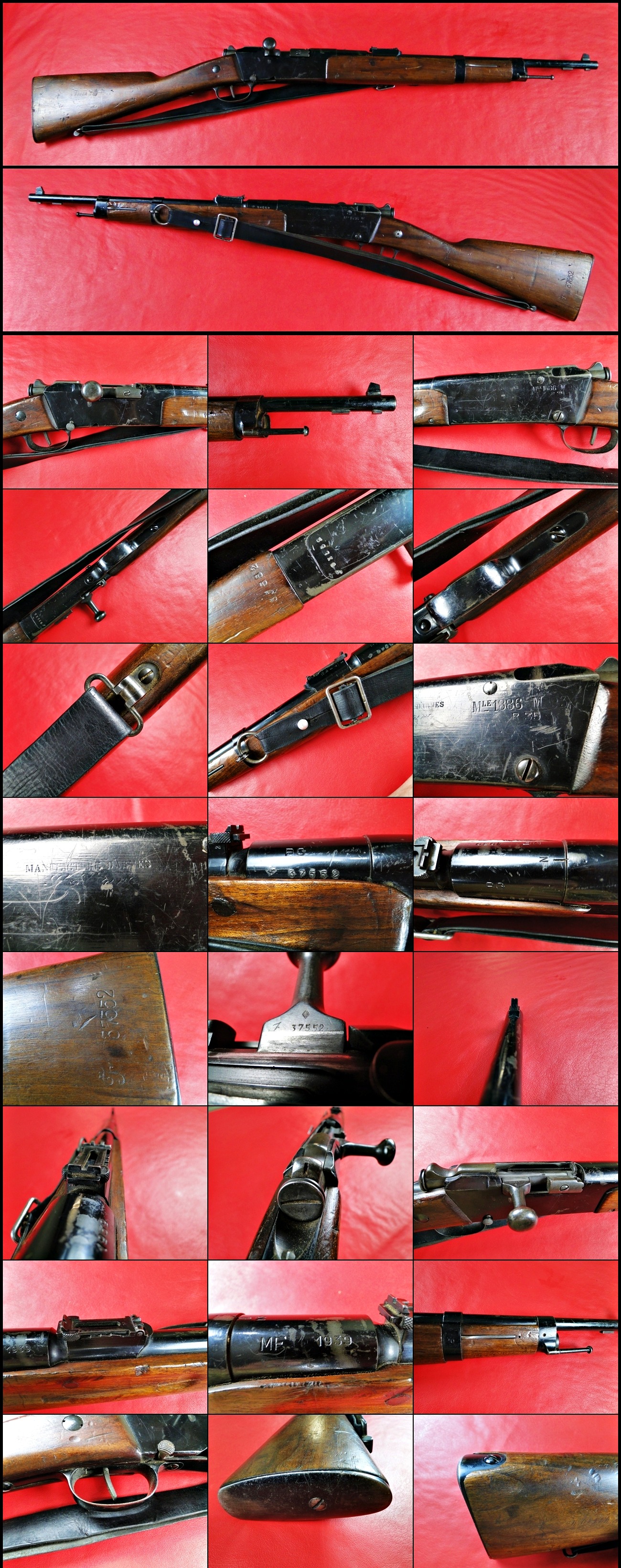
SMOF7961 - 1886 LEBEL R35 CARBINE MADE AT THE ST. ETIENNE ARSENAL ALL MATCHING SERIAL NUMBER F37552 8MM LEBEL
In 1884 French chemist Paul Vieille discovered the first practical (and stable) formulation for smokeless powder. Recognizing the military significance of this discovery, France attempted to keep the formulation a state secret while new small arms were developed around the discovery. A committee of French officers was convened to develop a new smokeless rifle.
In January of 1886 General Boulanger was appointed to the position of Minister of War. Eager to capitalize on the discovery of smokeless powder, Boulanger set a deadline of May 1st 1886 for the committee to complete the design of the new rifle and cartridge. With such a small amount of time the only option available to the French was to adapt old designs. Prior to Boulanger`s appointment, the committee had experimented with necking down the old 11mm Gras round to different diameters. These experiments led to the conclusion that 8mm was the ideal diameter. With a round decided on, the committee began to update the current Kropatschek design into the smokeless era. The committee successfully delivered the new rifle and round the General Boulanger by the May 1st deadline.
In early 1887 the 1886 Lebel rifle was adopted and production began at St. Etienne, Chatellerault, and Tulle. Production of the Lebel ceased in 1904 after rearmament of the French army was completed. The Lebel rifle would continue to serve France well into the 20th century.
In the 1930`s France began to prepare for what it anticipated was another large scale conflict with Germany. Hundreds of thousands of Lebel rifles were warehoused following the Great War for just such a possibility, but these rifles had been made all but obsolete by the 7.5 x 54 round and the MAS 36 rifle. France began the R35 update to the Lebel rifle in an attempt to make the Lebel system handier for rear echelon troops while freeing up the MAS 36 for front line use.
This history of this rifle can be traced somewhat due to its markings. The French did not serialize receivers as they considered the barrel to be the "gun." Serial number F37552 was originally assigned to St. Etienne for production in 1887, the first year production for the Lebel. The R35 update used a new barrel with the original serial number applied. The barrel is marked MF 1939, indicating that the barrel was produced by ManuFrance, a private contractor, in 1939. During the R35 update, rifles would have serial numbers matched if they were not already. This process sometimes led to serial numbers being milled out of the stocks, and a new piece of wood being inserted with the correct serial number. New stock sets were given a sling bar near the serial number rather than retaining the bottom sling mounting point. This rifle does not have any such features, and was likely matching when converted to an R35.
This is an excellent example of an R35 Lebel. All numbers are matching. The finish is correct black enamel paint with parkerization visible under areas where the paint is flaking. A step is present on the barrel under the nose cap, indicating an original R35 barrel. Stock set is in good condition, with only the usual defects from being moved around in a safe. Bore is bright with strong rifling. No import mark. $2250.00 (View Picture)
SMOF7824 - NEW ENGLAND WESTINGHOUSE MODEL 1891 MOSIN NAGANT SERIAL NUMBER 212109 CALIBER 7.62 X 54R
In 1891 Russia adopted a new rifle system primarily designed by Russian Sergei Mosin with design elements from Belgian Leon Nagant incorporated into the design. Initial production of the new 1891 rifle at the Russian arsenals of Izhevsk and Tula was slow, so contracts were granted to the French arsenal Chatellerault, and a third Russian arsenal at Sestroryetsk, in 1892. Further production of the 1891 rifle began at American firms Remington and New England Westinghouse in 1915 during the Great War.
During the First World War the Imperial Russian government quickly discovered that it had not calculated its need for arms and ammunition properly for a protracted conflict. Wastage of rifles was calculated at approximately 200,000 units per month due to damage, theft, attrition, or other undetermined causes. Because of this American firms Remington and New England Westinghouse were contracted to produce model 1891 Mosin Nagant rifles. By the cancellation of the contract New England Westinghouse had delivered over one million 1891 rifles.
This rifle is an 1891 Mosin Nagant produced by New England Westinghouse. Receiver and barrel are matching Westinghouse. Numbers on the bolt and barrel are matching. At some point prior to World War Two this rifle became Finnish property, as indicated by the boxed SA mark (only applied after 1942), jointed stock, remarked rear sight, and updated sling furniture. The barrel has been counter bored, but the bore is bright and the rifling is strong. No import mark is present. Finish would rate about 95%, with slight wear in high spots and handling areas.
American Mosin Nagant`s represent an interesting part of world history. These rifles are becoming more difficult to find, and this is one of the first we have had for sale in several years. $1195.00 (View Picture)
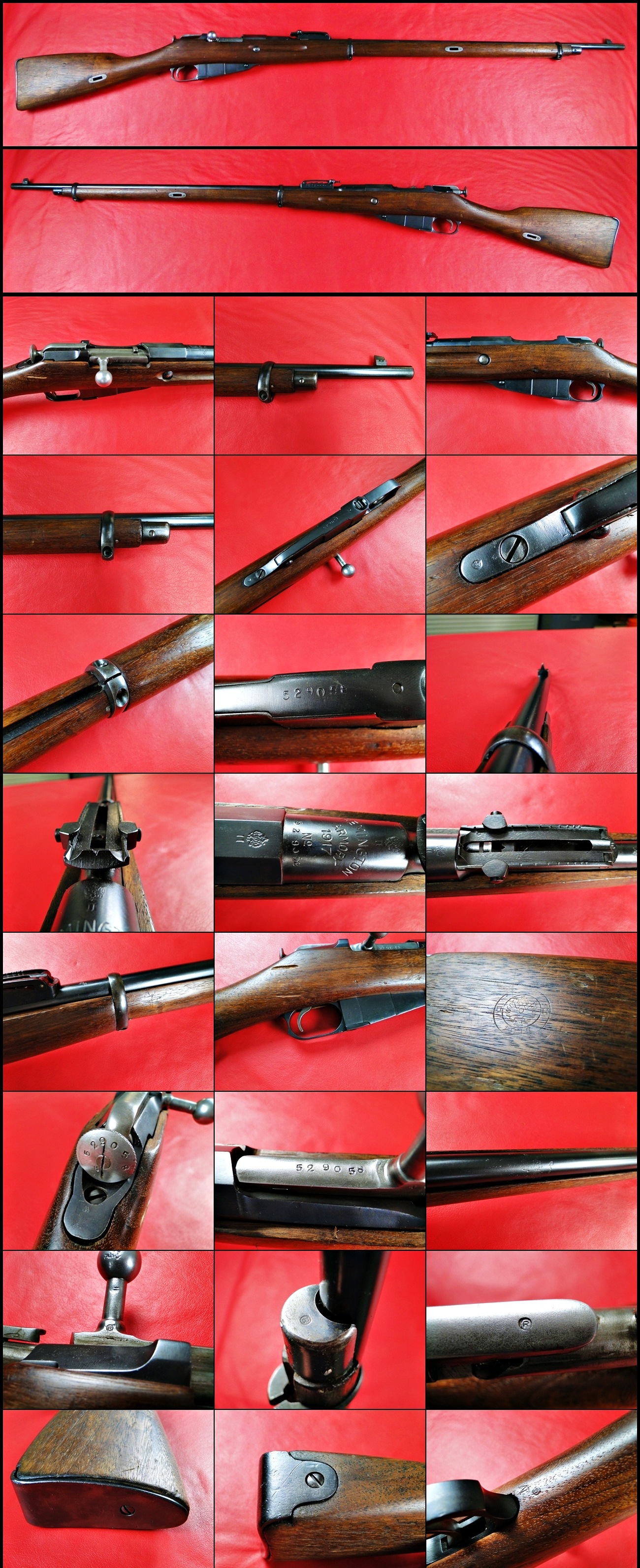
**SOLD** SMOF7874 - REMINGTON MODEL 1891 MOSIN NAGANT SERIAL NUMBER 529058 CALIBER 7.62 X 54R
In 1891 Russia adopted a new rifle system primarily designed by Russian Sergei Mosin with design elements from Belgian Leon Nagant incorporated into the design. Initial production of the new 1891 rifle at the Russian arsenals of Izhevsk and Tula was slow, so contracts were granted to the French arsenal Chatellerault, and a third Russian arsenal at Sestroryetsk, in 1892. Further production of the 1891 rifle began at American firms Remington and New England Westinghouse in 1915 during the Great War.
During the First World War the Imperial Russian government quickly discovered that it had not calculated its need for arms and ammunition properly for a protracted conflict. Wastage of rifles was calculated at approximately 200,000 units per month due to damage, theft, attrition, or other undetermined causes. Because of this American firms Remington and New England Westinghouse were contracted to produce model 1891 Mosin Nagant rifles. Remington was contracted to produce over 1,500,000 for the Russian government. By the fall of the Kerensky government in November of 1917, Remington had recorded shipment of 600,000 rifles, with approximately 75,000 rifles remaining in the factory in various stages of completion. The government of the United States then purchased the remaining stock of 1891 rifles from Remington to avoid financial insolvency at the firm.
This rifle is an 1891 Mosin Nagant produced by Remington. Receiver, barrel, and all small parts are matching Remington. Numbers on the bolt, barrel, magazine, and cocking knob are matching. The butt plate is not numbered. The bore is bright and the rifling is strong. No import mark is present. Finish would rate about 98%. The stock has a strong Remington 1917 dated cartouche near the butt.
According to Luke Mercaldo`s fantastic "Allied Rifle Contracts in America," the rifles purchased from Remington by the United States government were dated 1917 on the barrel, and fall in the serial number range of 500,000 to 590,000. This rifle is consistent with those two requirements, but is missing the distinctive screaming eagle over a flaming bomb mark fore of the magazine. We suspect that this rifle was purchased by the US, but we will allow the future owner of this fine rifle to draw their own conclusion. If only the folks at the arsenals thought of us collectors!
American Mosin Nagant`s represent an interesting part of world history. These rifles are becoming more difficult to find, particularly in this condition. $1295.00 (View Picture)
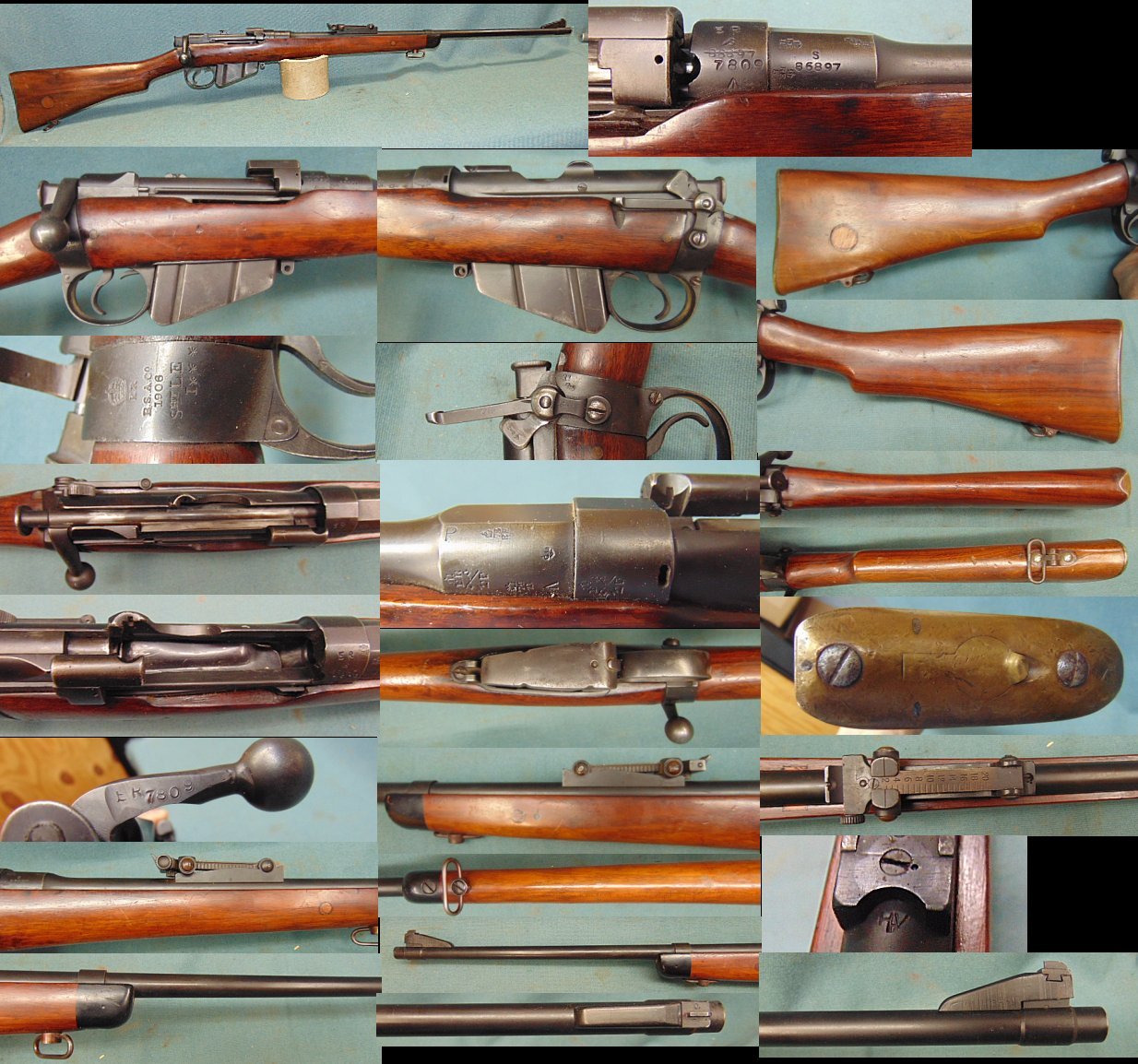
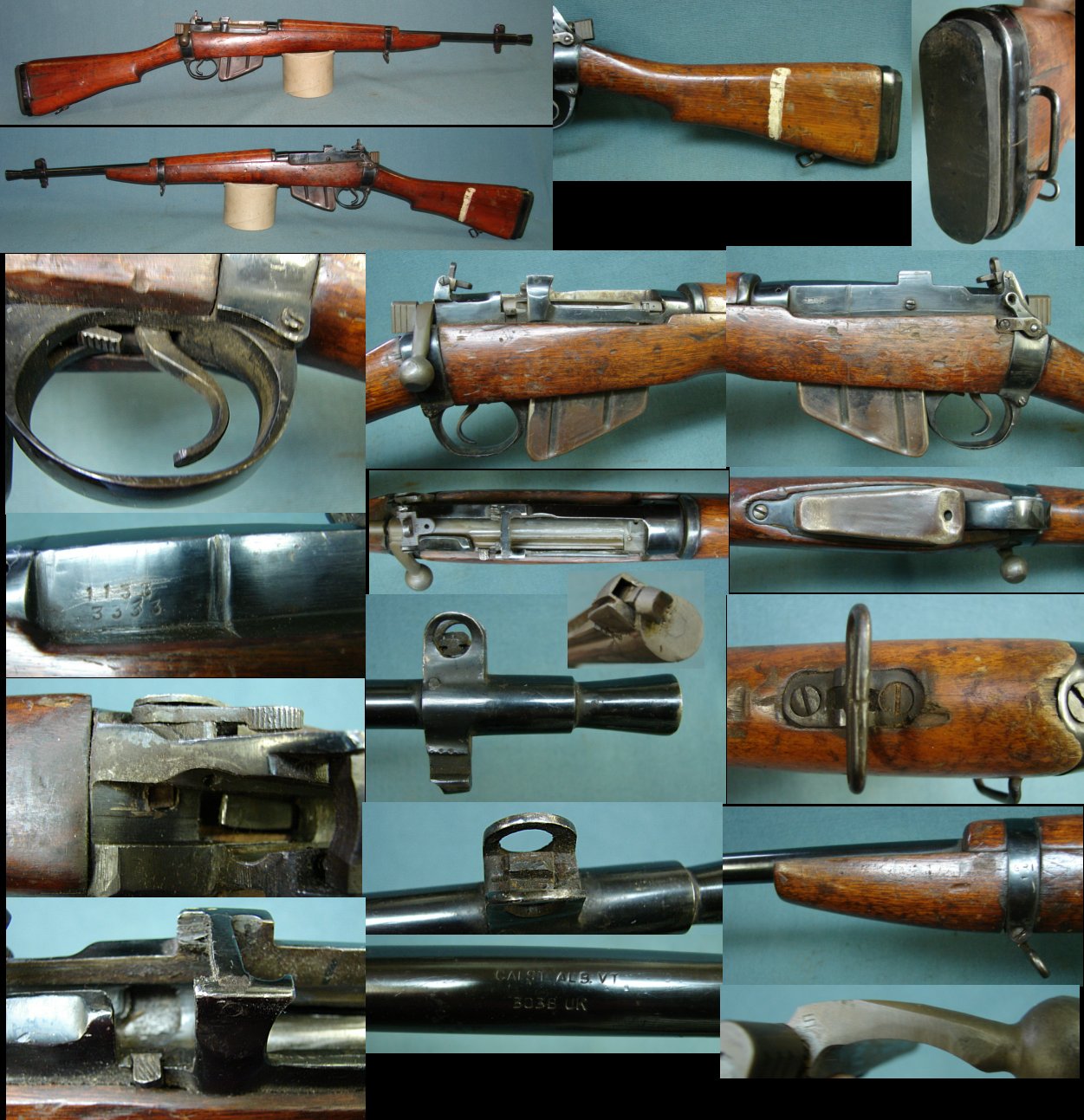
SMOF7964 - 2161 - SCARCE SHORT LEE ENFIELD MARK I*** .303 RIFLE MADE BY BIRMINGHAM SMALL ARMS IN 1906 (RESTORATION PROJECT)
Serial number ER 7809 over canceled 86897. Adopted in 1903, the "Short, Magazine. Lee Enfield Mark I" broke the tradition of having long rifles for infantry and short carbines for mounted troops and henceforth everyone would use the same intermediate length "short" rifle. These retained the same action as the "Long" Lee (and Metford) rifles, and used the same Mark VI cartridges with a heavy round nose bullet. However, the new rifles were full stocked and introduced the bulky but sturdy nose cap used on the later WW1 No. 1 Mark III/III* rifles. Recognizing the advantage of Mauser stripper clip loading, they included a fixed guide on the left side of the receiver, and a sliding guide on the top of the bolt head so when the bolt was back, it lined up and stripper clips could be used. Like most military programs in peacetime and constrained budgets, various minor changes were introduced piecemeal and overlapping between 1903 adoption of the Short Lee Enfield and the 1914 start of WW1. In 1907 the lighter weight spitzer bullet cartridge Mark VII was adopted, requiring modification of sights, and other minor changes.
Meanwhile, the No. 1 Mark III was being adopted about 1907 with a fixed bridge style stripper clip guide and other minor changes, even while contracts for the Mark I* remained in effect. In 1913 they adopted for trials the Mauser style Pattern 1913 in a new .276 rimless cartridge, which was quickly modified to the .303 caliber pattern 1914 rifle. Starting about 1914, the Brits got busy converting the early Mark I rifle to use the new Mark VII ammunition, and making any needed repairs, sometimes with newer parts, but restricted issue to certain categories of troops. Post WW1 the outdated Mark I (and *, ** and *** variant) series rifles went thru a quick clean and repair operation and were placed in storage.
In early 1923 the Brits sent about 10,000 rifles to the newly formed Irish Free State, engaged in the perpetual "troubles" among various factions over religion, governance, royalty, and genetic clover monkey pugnacity. These rifles had their original serial numbers struck through, and new ER prefixed serial numbers applied to barrel, receiver and bolt, for Irish record keeping. These remained in service until the 1950s, and in the early 1960s Sam Cummings` Interarmco "Ye Olde Hunter" outfit brought 4,105 of the Mark I*** rifles from Ireland to the U.S. Another batch had "CR" prefixes and are probably from a circa 1930 shipment to Ireland, and these show have Mark III style sights (lacking windage adjustment) and stocks with the Mark III sight protector fastened to the forend, not the handguard.
Forgotton Weapons did a good video on these at https://www.youtube.com/watch?v=72j36oCeD6c
and there is a lengthy forum discussion on the Mark I*** at https://www.gunboards.com/threads/lee- enfield-mark-i-questions.170768/
Ye Olde Hunter apparently "sporterized" quite a few of the Mark I*** rifles they imported to appeal to the deer hunter market, as there really were not many military surplus rifle collectors then, and they had mountains of .303 rifles to sell. The front sight is not modified, and the ramp is a stamped sheet metal part that is easily removed when the front sight blade is drifted out. The butt stock is unmodified, other than having the marking disc removed and filled. The screws for the butt swivel are incorrect replacements. The rear volley sight remains intact. Good bore. One sporterized nearly identical to this, but with the rare sliding charger guide removed and some chrome plated parts recently sold on GunBroker for $410.00. One of the CR prefix guns with the Mark III style sights and NOT sporterized sold on GunBroker (item 1073915991) for $2,500.00
This is an important milestone in the Lee Enfield story, and well worth the effort to restore it to more original configuration. The easiest and cheapest way would be to use No. 1 Mark III forend stock and furniture, although it originally had the earlier rear sight protector on the handguard, not the forend. Prestigious Wood Stocks (located in Canada, but no problems shipping to the U.S.) has very high quality reproduction stocks available for this specific model, and many other arms: https://www.prestigiouswoodstocks.com/products/lee-enfield-no-1-mk-l-lower-forestock
It would be nice to see this one restored, and in its present condition it is a bargain at only $550.00 (View Picture)
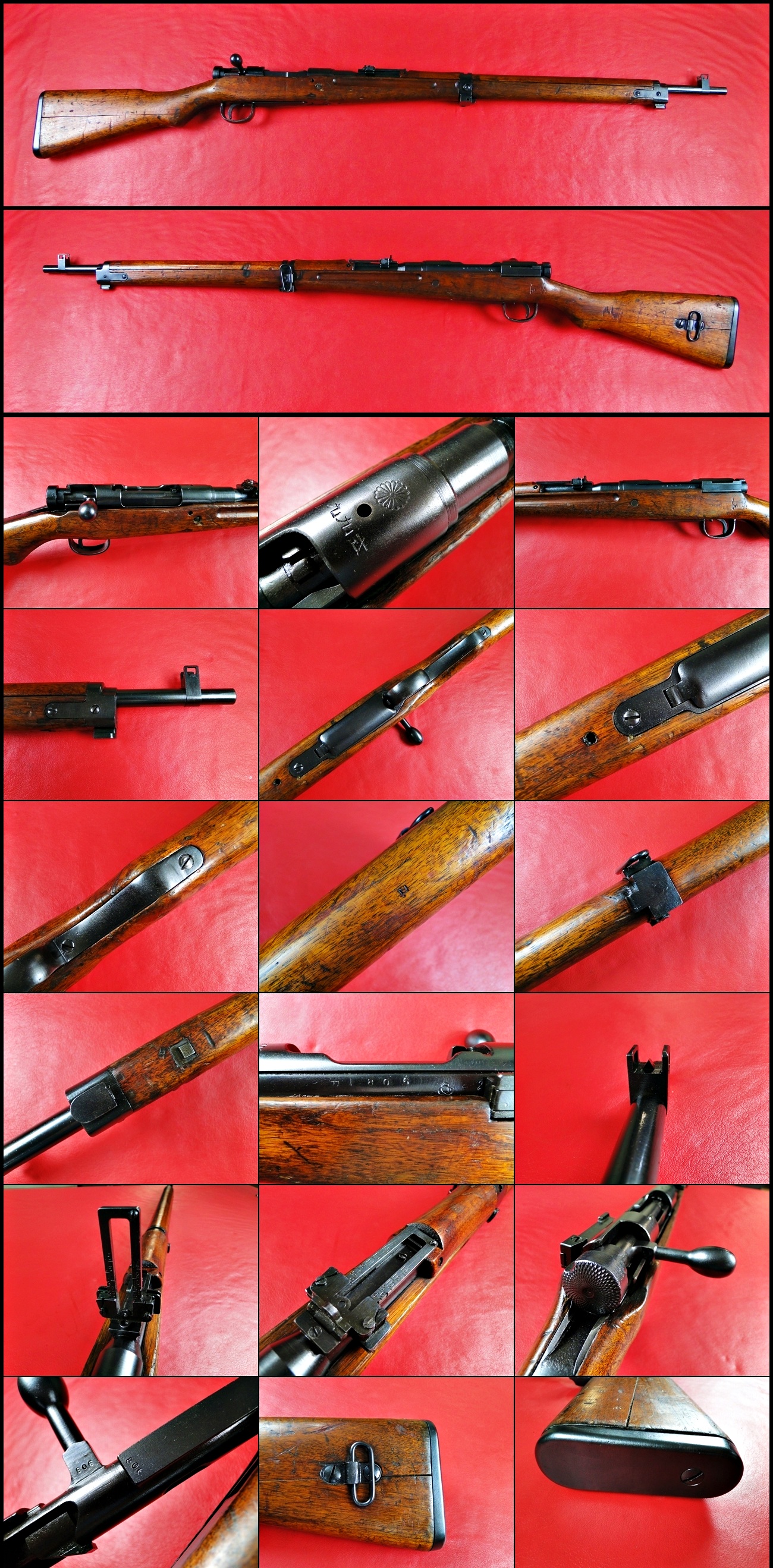
SMOF7711 - TYPE 99 JAPANESE WORLD WAR II RIFLE MADE AT THE KOKURA ARSENAL 21ST SERIES. ALL MATCHING SERIAL NUMBER 1806.
Japan entered the industrial age with the single minded determination to create the industrial base equivalent to the one that had allow the European navies to force their country to open its people to trade. The Japanese quickly created a firearms industry unlike the Chinese who continued to purchase most of their small arms in Europe. By 1905 the Japanese Army had developed the strongest bolt action rifle in the world when they adopted the Type 38 in 6.5 mm. In 1939 the military decided to increase the caliber of their rifles to 7.7 mm, and introduced the Type 99 rifle. It used the basic action of Type 38, and was the first military rifle to have a chrome lined barrel. P.O. Ackley, the noted gunsmith compared the Japanese military bolt action rifles of World War II to those of Germany, England and the U.S. by seeing which ones could withstand the highest pressure loads. The Japanese bolt actions were still shooting when all the other actions, including the Mauser, had blown up.
The Imperial Japanese army had used their 6.5 mm Type 38 rifles in China. The units going to the Pacific island were generally armed with the Type 99 rifle. The Type 99 rifle was the ones most of our GI's encountered in the actions that rolled back the Japanese Empire from Guadalcanal to Okinawa.
This rifle retains the mum, and all numbers are matching. Bluing is in superior condition, and would rate conservatively at 95%+. Chrome lined bore is in excellent condition. No import mark is present. Desirable features such as the knurled safety, adjustable rear sight, and plum bolt handle are present. This rifle is an interesting example of the Type 99, sure to please collectors. $850.00 (View Picture)
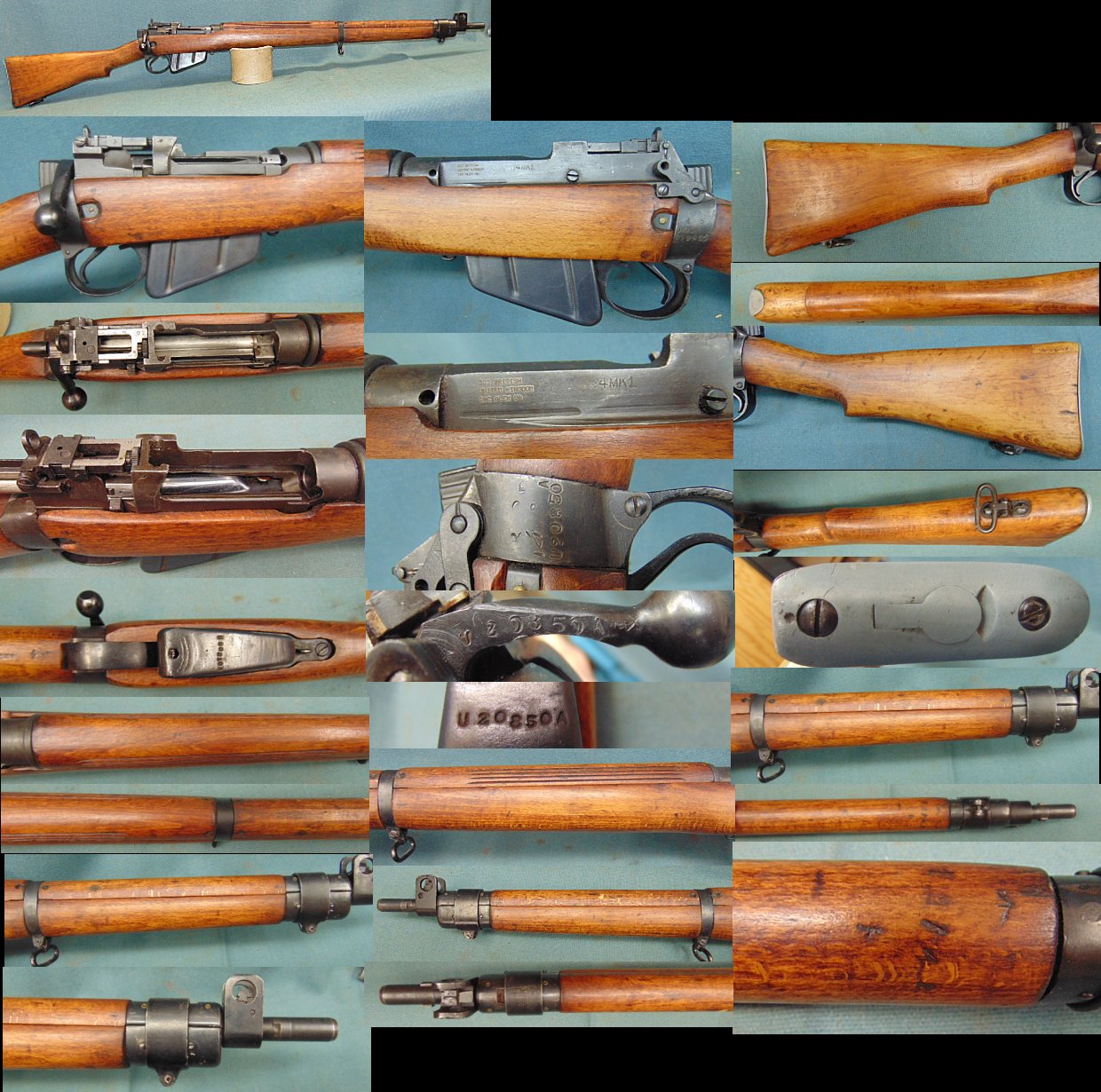
SMOF7963 - 2160 - WW2 BRITISH NO 4 MARK I .303 LEE ENFIELD RIFLE MADE BY ROF FAZAKERLY -
Serial number U20850A, matching on the receiver (left side of butt socket), bolt and magazine. Numbers on forend are illegible. Import marked on left side of receiver.
No. 4 Enfield markings are a bit confusing, but once understood, it is easy to identify some of the British makers (but the Long Branch and Savage rifles used a different system). Royal Ordnance Factory (ROF) Maltby used serial numbers with 5 digits, starting with "1" (10001, 10002, etc to 19999) Then they added a letter A in front of the number, running A10001 to A19999, then changed from A to B prefix, etc until they finished the Z series then started over with AA, the AB, AC, etc, but all 5 digit numbers starting with 1. ROF Fazakerly used a similar pattern, but all numbers started with 2, and the BSA Shirley plant used a similar pattern starting with 3. However, there are several exceptions to this pattern and Skennerton`s books will help understand those. For all of the makers, if there was any part on the gun which was non-standard (i.e. might need hand fitting or slightly different part, but otherwise serviceable, the letter "A" was added as a suffix to the serial number. This warned armorers that it might take longer to return those rifles to service than the fully interchangeable guns.
This rifle was made sometime early in 1943, and has the milled fine adjustable rear sight, not the simple "L" flip sight adopted later in the war. Overall about 95% original rough blued finish remains. Beech stocks are in good condition, showing the expected dings of an issued military arm. Military (unit level) repair at the heel of the buttstock, but no indication it was ever arsenal overhauled as there are no "FR" or "FTR" markings. Good mechanics. Has plastic oil bottle in the butt. Two groove rifling is good, but shows some use. IAC ALX VA importer markings on left side of receiver, otherwise a nice unmolested example of the main British battle rifle of WW2 and Korea, and also used throughout the Empire. $795.00 (View Picture)
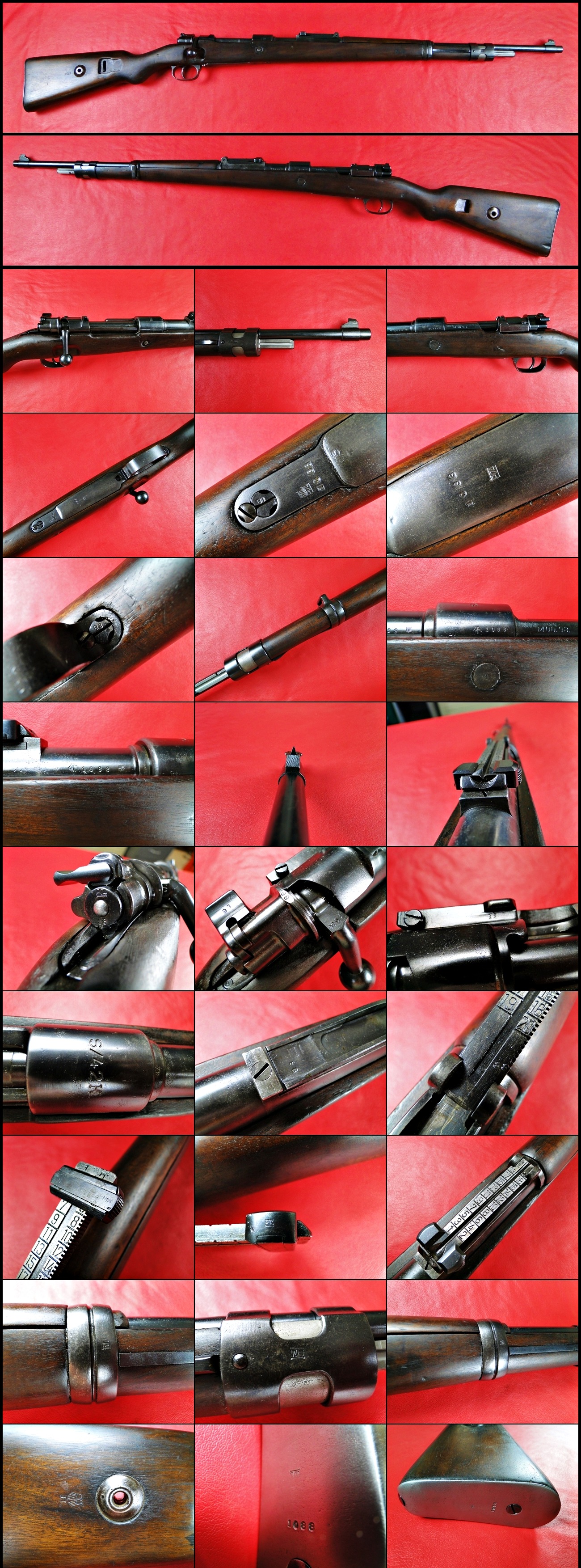
SMOF7948 - RARE, EARLY MAUSER K98K IN 8MM SERIAL NUMBER 1088 K DATE
This is the rarest and most sought after of all of the 98k Mauser rifle variants. The Initial production 1934 "K" Date Mauser Oberndorf made K98k Service Rifle. The rifle is coded with the secret code S/42K, 1934 Mauser 98k`s just do not exist. The K rifles were introduced during the early years of the Nazi Party`s dominance of Germany, the code system was intended to obscure the scale and speed of German re-armament. Nice K Date K98ks are seldom available to the collector market. They were used hard for many years prior to the outbreak of war and only a small number were manufactured (16,000).
This is a nice example of the earliest production of this legendary rifle. This rare K Date Mauser K98k that was manufactured in 1934 features all matching numbers, it has an excellent finish with light pitting in some areas. The finish rates at about 96%. The bayonet lug and area under the front barrel band is `in the white`, a feature of these early rifles that helps to ensure original bluing. All numbered parts match the receiver, including the hand guard, as well as the stock (internally numbered) and butt plate. Stock may have been lightly sanded but has good Heer markings. The bore is dark but it has strong lands and grooves, it may or may not clean up. There are loads of early acceptance proofs on most of the small parts of the rifle. $5500.00 (View Picture)
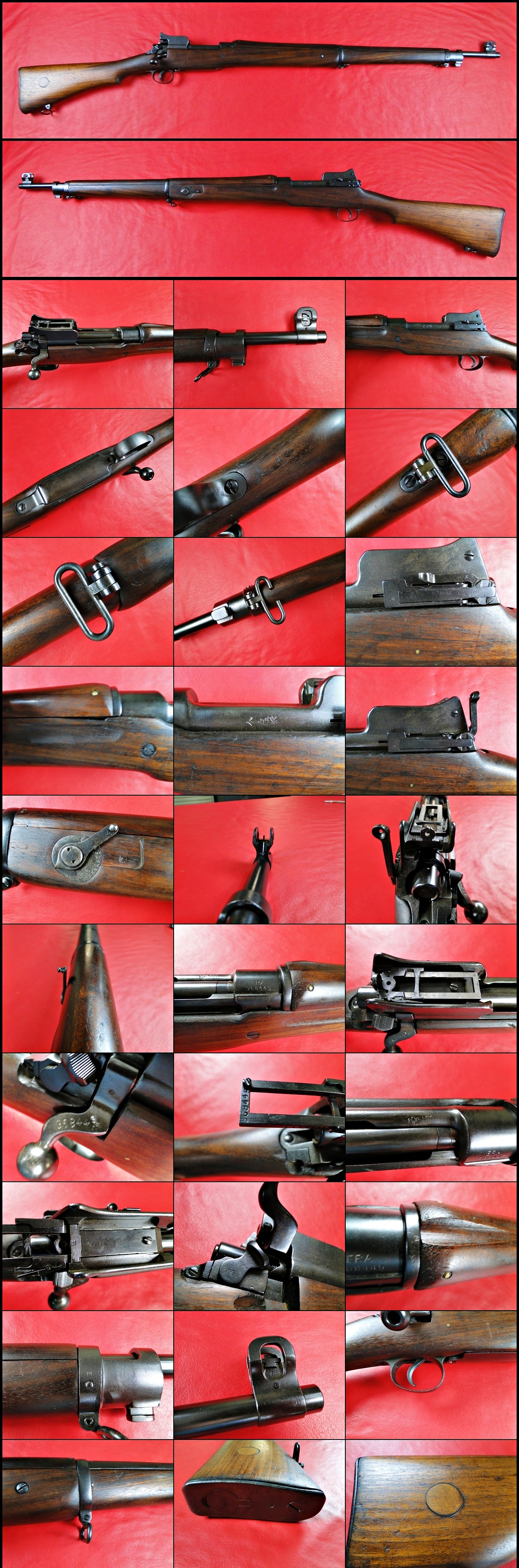
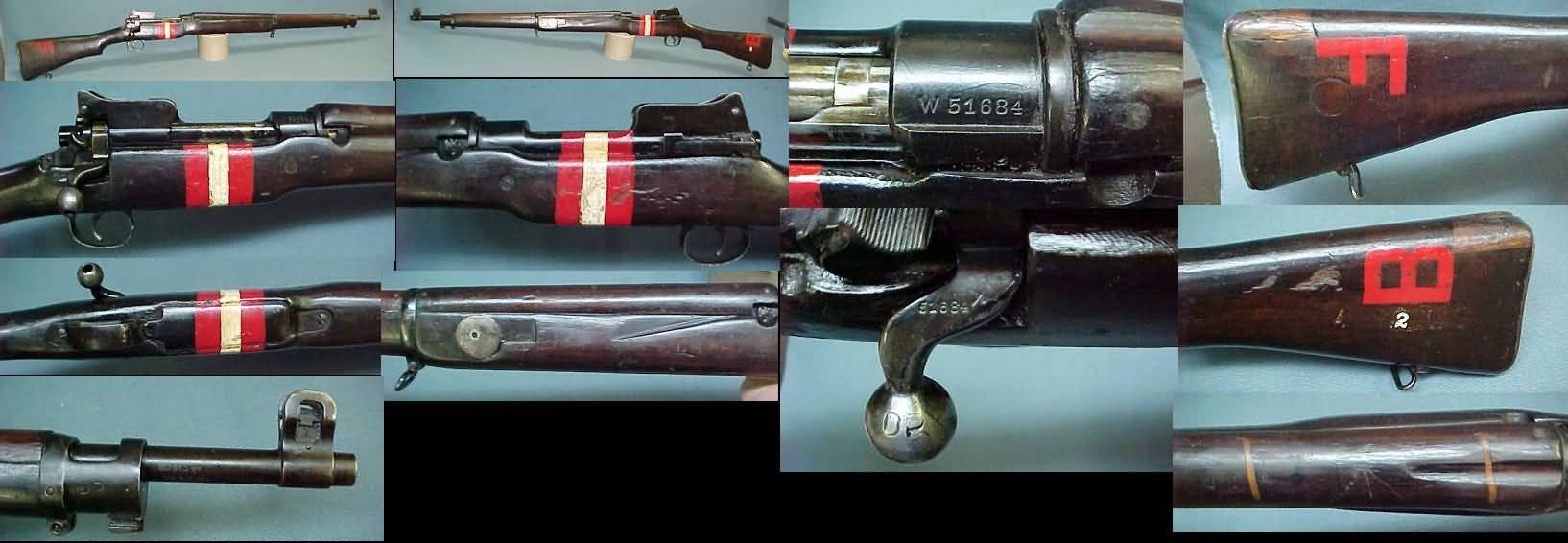
**SOLD** SMOF7926 - EXCELLENT BRITISH PATTERN 1914 (P.14 ENFIELD) .303 CALIBER RIFLE MADE BY EDDYSTONE SERIAL NUMBER 368445 WITH VOLLEY SIGHTS, ALL MATCHING EDDYSTONE PARTS AND MATCHING NUMBERS - NICE!
After the conclusion of the Second Boer War the British determined that the Lee Enfield rifle was outclassed by the more modern Mauser style rifle often carried by the Boers. A small arms committee was assembled to evaluate various rifle designs. In 1913 the British ran trials on a new Mauser influenced design, which shot the speedy .276 Enfield cartridge (comparable to modern 7MM Remington Magnum!). When the Great War began in 1914 the British determined that logistical simplicity was preferred over cartridge performance, and the Pattern 1913 was reworked to shoot the 303 British. This change resulted in the Pattern 14 rifle.
The British, desperate for a supplement to their small arms production capability at home, contracted with three American companies to produce the Pattern 14 rifle: Winchester, Remington, and Remington subsidiary Eddystone. The rush to produce arms for the war effort gave the American companies little time to perfect tooling and correct flaws in technical drawings which led to poor parts interchangeability between the three manufacturers. As the war progressed improvements were made which not only improved parts interchangeability, but improved the overall function of the rifle. Total rifle production was approximately 1.2 million units, with deliveries being made through 1917.
This is a handsome example of a Pattern 14 rifle. The bore is shiny and the rifling is strong. The blue is excellent and would rate at 98%+. Serial numbers on the receiver, barrel, and bolt are matching. All small parts have the "E" Eddystone mark. $1200.00 (View Picture)
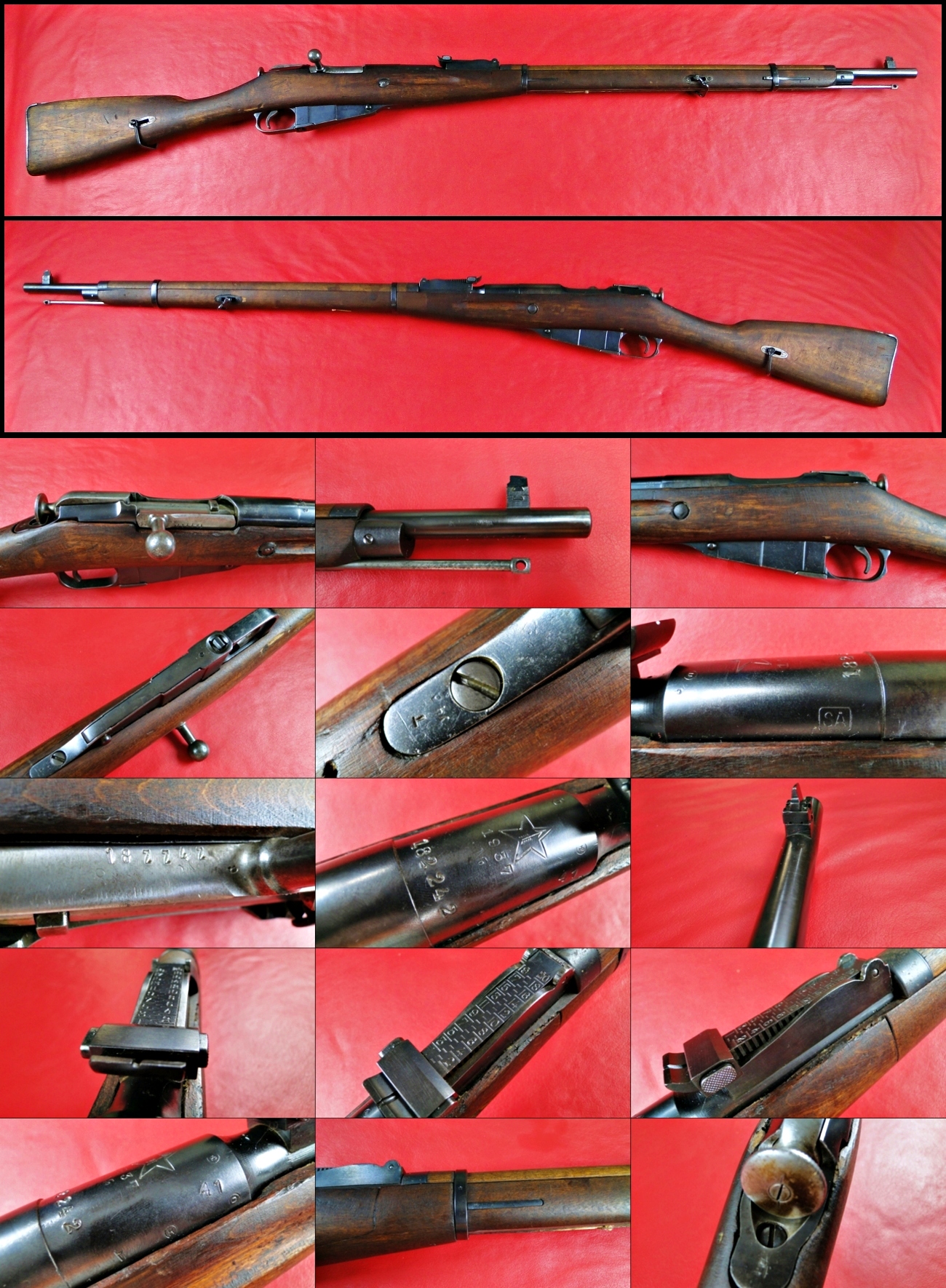
SMOF7928 - EXCELLENT FINNISH TULA 91/30 MOSIN NAGANT SERIAL NUMBER 182242 CALIBER 7.62X54R
In 1891 Russia adopted a new rifle system primarily designed by Russian Sergei Mosin with design elements from Belgian Leon Nagant incorporated into the design. Initial production of the new 1891 rifle at the Russian arsenals of Izhevsk and Tula was slow, so contracts were granted to the French arsenal Chatellerault, and a third Russian arsenal at Sestroryetsk, in 1892. Further production of the 1891 rifle began at American firms Remington and New England Westinghouse in 1915 during the Great War.
In 1930 the Soviet government began an over haul program to update and repair rifles currently held in inventory. Old rear sights measured out in arshini were discarded in favor of new metric sights, the old front sight blade was traded for a globe and post style front sight, barrel lengths were standardized, and remnants of Imperial markings were scrubbed or defaced. Production of the hexagonal receiver was phased out in favor of a round receiver to expedite production and save materials. Modernization of the 1891 rifle was not immediate. Changes were implemented gradually, often as rifles in outdated configurations returned to arsenals for repair.
In November of 1939 the Soviet Union invaded Finland, initiating the Winter War. Hostilities were ceased in March of 1940, only to resume in June of 1941 in what was called the Continuation War. During both conflicts the Finns captured and repurposed vast quantities of Soviet material, including the new pattern of Mosin Nagant rifle.
This rifle is Finnish captured 91/30. The Finns made slight refinements to captured 91/30`s to make them better approximate Finnish preferences. The globe and post style front sight was discarded for a barleycorn front sight, stocks were jointed to make them more durable in harsh winter conditions, and Finnish sling hangers were added. The barrel and receiver dates are a matching Tula 1937. The finish would rate at about 95%+. The bore is bright and would rate above average, but has been counter bored. All numbers are matching. No import mark is present. $650.00 (View Picture)
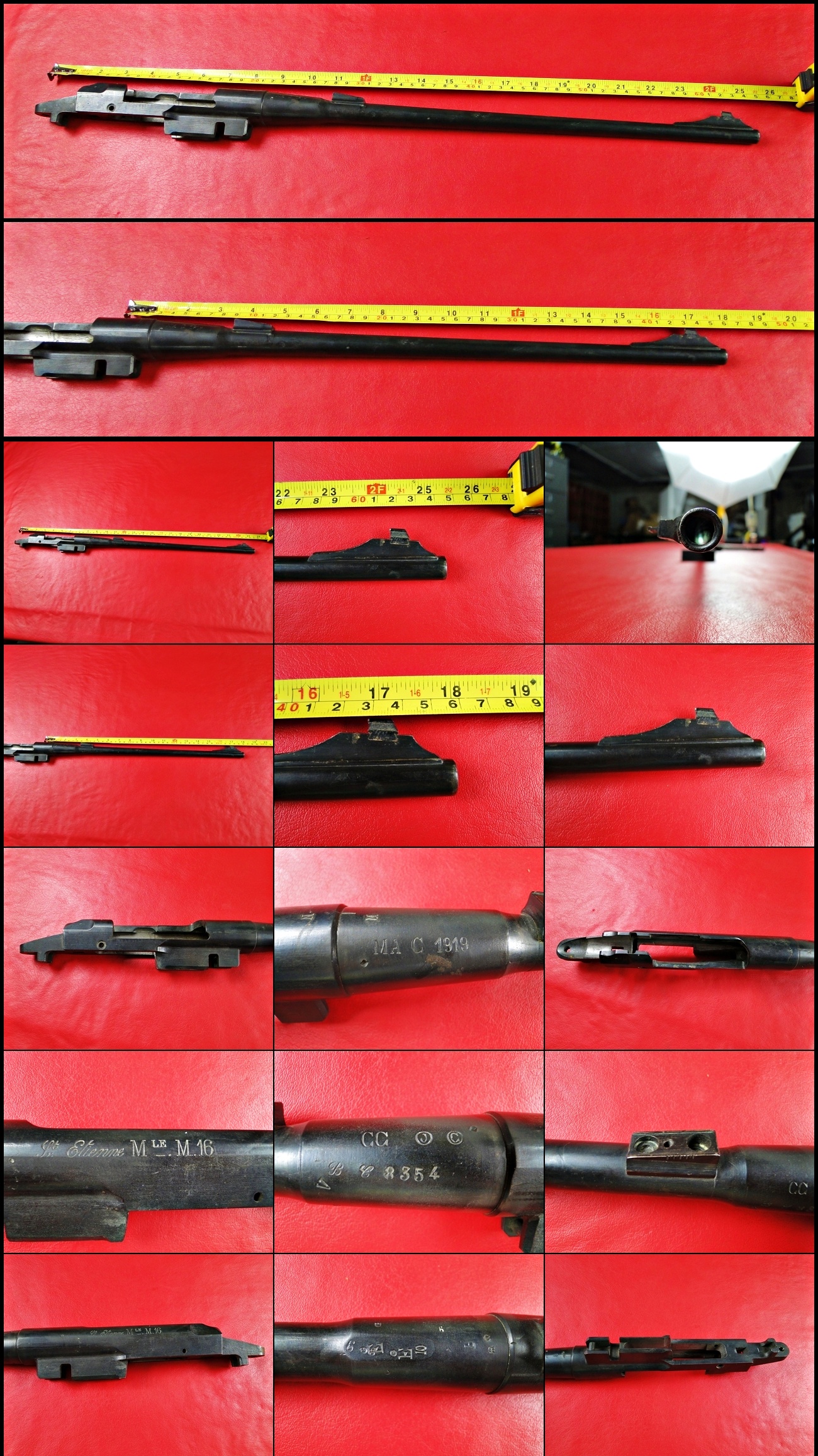
SMOF7942 - FRENCH MANNLICHER-BERTHIER MODEL 1916 BARRELED RECEIVER IN 8 X 50MMR LEBEL CALIBER.
Barrel cut to 18 inches and sporter style ramp front sight added. Decent but dirty bore, it may or may not clean up. Lots of blue finish. What you see is what you get. Since this includes a receiver it has to go to a FFL holder. $75.00 (View Picture)
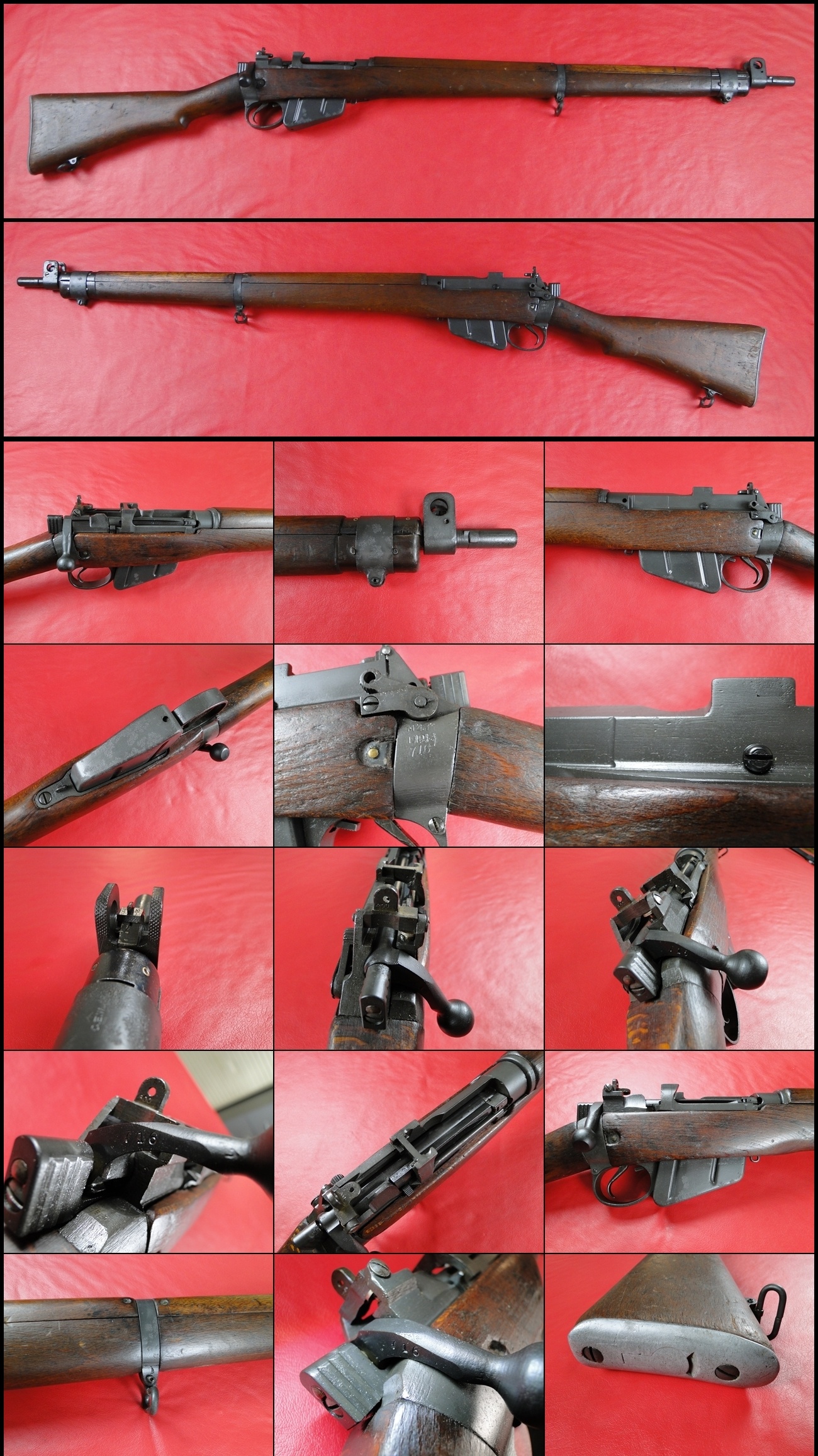
SMOF7756 - NO. 4 MARK I RIFLE MADE B.S.A SHIRLEY MADE IN 1939 CALIBER 303 BRITISH. SERIAL NUMBER 716
The British Army adopted a magazine loaded bolt action rifle in 1888. The design came from a Scottish emigrant to the U.S., James Lee, and featured a 10 round, top loading, detachable magazine, with a bolt with rear locking lugs. It was modified after the Boer War based on the exposure to the Mauser Boers. The barrel was shortened, and a receiver bridge added for loading with stripper clips. The Lee-Enfield action continued in British (and Commonwealth) service until 1955. It is considered one of the best designed battle rifles in the world. The ten round magazine gave it an advantage over all other bolt action rifles. The rear locking lugs were much less likely to foul with dirt, and the bolt could be operated more rapidly than the standard Mauser bolt.
In 1924 the British began development of the Number 1 Mark VI rifle. Major changes to the Number 1 Mark VI rifle include moving the rear sight to the receiver bridge, changing stock fitment and furniture, and the development of a fine adjustable micrometer rear sight.
In 1931 the British changed their rifle designation nomenclature. What was formerly the Short Magazine Lee Enfield Rifle Number 1 Mark VI became known as simply as the Rifle Number 4, which was adopted by the British near the end of 1939. Production of the Number 4 rifle would begin in 1941 at Maltby, followed by Fazakerly and B.S.A Shirley. North American firms Long Branch and Savage would also produce the Number 4 rifle.
This is rifle was made at B.S.A Shirley early in production. The socket is marked with a date that is difficult to read, but is likely 1939. Barrel, action, and bolt are matching. Bore has pitting but strong rifling is present. Finish would rate 95%+. No import mark is present. $650.00 (View Picture)
SMOF7833 - EXCELLENT ALL MATCHING! KAR 98K MADE BY DOT (BRNO) IN 1943 SERIAL NUMBER 3677C CALIBER 8 MM MAUSER
The Karbiner 98 Kurtz (Carbine 98 short) or Kar 98k was the standard service rifle of the German Military during World War II. It was developed from the Gewehr (rifle) 1898 designed by the Mauser company and adopted by the German army in 1898. Over 10 million were made between 1934 and 1946 when production ceased. The Kar 98k was rugged, reliable and accurate. The large number of Kar 98k receivers that have formed the basis for a custom magnum rifle is testimony to the soundness of the design.
In 1938-1939 Hitler had taken over Czechoslovakia. The Czechs had well developed firearms industry that the Germans put to work for their army. The firearms factory at Brno had been making the VZ 24 rifle for export, and continued to make them for the German army. Changes were made to the rifle until it had become a Kar 98k. By 1942 the huge battles on the Eastern front resulted in the loss of large numbers of Kar 98k rifles. In 1943 the Waffenwerke at Brno began to produce large numbers of Kar 98k rifles to replace these losses. The Czech arms industry was considered one of the finest in Europe.
This rifle in excellent condition with matching stock. All of the numbers match including the numbers on the receiver, bolt, barrel, trigger guard/floorplate barrel bands and action screws. Bluing would rate about 95% +. The bore is dark but has strong lands and grooves, it may or may not clean up. The stock is in very good condition with some small arsenal repairs. The stock has traces of Nazi Heer stamping remaining. $1995.00 (View Picture)
SMOF7892 - EXCELLENT NO. 4 MARK I* RIFLE MADE AT LONG BRANCH IN 1942 CALIBER 303 BRITISH. SERIAL NUMBER 14L8967
The British Army adopted a magazine loaded bolt action rifle in 1888. The design came from a Scottish emigrant to the U.S., James Lee, and featured a 10 round, top loading, detachable magazine, with a bolt with rear locking lugs. It was modified after the Boer War based on the exposure to the Mauser Boers. The barrel was shortened, and a receiver bridge added for loading with stripper clips. The Lee-Enfield action continued in British (and Commonwealth) service until 1955. It is considered one of the best designed battle rifles in the world. The ten round magazine gave it an advantage over all other bolt action rifles. The rear locking lugs were much less likely to foul with dirt, and the bolt could be operated more rapidly than the standard Mauser bolt.
In 1924 the British began development of the Number 1 Mark VI rifle. Major changes to the Number 1 Mark VI rifle include moving the rear sight to the receiver bridge, changing stock fitment and furniture, and the development of a fine adjustable micrometer rear sight.
In 1931 the British changed their rifle designation nomenclature. What was formerly the Short Magazine Lee Enfield Rifle Number 1 Mark VI became known as simply as the Rifle Number 4, which was adopted by the British near the end of 1939. Production of the Number 4 rifle would begin in 1941 at Maltby, followed by Fazakerly and B.S.A Shirley. North American firms Long Branch and Savage would also produce the Number 4 rifle.
The Long Branch arsenal was located in the Canadian province of Southern Ontario on lands owned by the Canadian government. Formerly a rifle range, military use was expanded during the First World War. In 1940 the construction of a factory was authorized, and Small Arms Limited was formed to operate the facility. Production of small arms began in 1941. Long Branch continued to produce and refurbish small arms until 1976, when the factory was closed.
At the end of the Second World War, the government of New Zealand decided to update their small arms and adopted the No. 4 rifle in favor of the aging No. 1 which they had used throughout the conflict. As technology and time progressed, New Zealand adopted the L1A1 SLR, and released many of its No. 4 rifles to the public.
This rifle is an exceptional example of a No. 4 and has an interesting provenance. This rifle was made in the Great White North during World War II, and then acquired by New Zealand sometime after hostilities ended. It then made its way to the United States prior to 1968, noted by the lack of import marks. The Canadian serial numbers on the receiver, stock, and bolt are matching. New Zealand applied a second serial number to the bolt and receiver socket, which is also matching. The bore is bright and has strong rifling. Original finish is excellent condition and would rate above 97%. $950.00 (View Picture)
SMOF7872 - ALL MATCHING GERMAN KAR 98K CE42 (J.P. SAUER UND SOHN) MARKED SERIAL NUMBER 6239M CALIBER 8 MM MAUSER
The Karbiner 98 kurtz (Carbine 98 short) or Kar 98k was the standard service rifle of the German Military during World War II. It was developed from the Gewehr (rifle) 1898 designed by the Mauser company and adopted by the German army in 1898. The Germans shortened it to carbine length barrel in 1934 and it became the standard rifle for all German infantrymen. Over 10 million were made between 1934 and May 1945 when most production ceased. The Kar 98k was rugged, reliable, and accurate. The large number of Kar 98k receivers that have formed the basis for a custom magnum rifle in the United States is testimony to the soundness of the design.
Initial production of the k98k rifle began in 1934 at Mauser and J.P Sauer, skirting the stipulations of the Treaty of Versailles which had limited German arms production at the end of the Great War. During the Second World War J.P. Sauer und Sohn of Suhl produced over one million rifles for the German war effort, in addition to the 38H semi-automatic pistol and variants of the STG44.
In April of 1945 American forces arrived in Suhl and occupied the Sauer factory. Suhl was eventually in what would become the Soviet occupation zone. In the years after the war the assets of the J.P. Sauer Company were merged into a Soviet conglomerate known as VVB MEWA Suhl, intended to make sewing machines and other small home appliances.
In 1951 the rights to the name and trademarks owned by the J.P. Sauer Company were sold to a new enterprise, which began making sporting firearms in West Germany. In 1972 the Swiss company Schweizerische Industrie Gesellschaft (better known as SIG) purchased the J.P. Sauer Company in an effort to circumvent Swiss neutrality and export laws, creating the modern company Sig Sauer.
This rifle was made at the J.P. Sauer und Sohn factory in Suhl Germany in 1942. All numbers are matching and all parts are of the correct vintage for the rifle. A faint Eagle over H stamp is visible on the stock near the bolt take down disc, indicating acceptance by the Heer, or army. Two faint repairs are visible near the toe and fore end of the stock. The bore is in excellent mirror bright condition, with strong rifling. No import mark is present. Finish would rate at 95% plus. $2495.00 (View Picture)
SMOF7837 - RUSSIAN MADE SKS 7.62 X 39MM MADE BY TULA IN 1950 (THE SECOND YEAR OF PRODUCTION) WITH FOLDING KNIFE BAYONET- NICE!
The SKS (Samozaryadnyj Karabin sistemy Simonova) was designed in 1945 by Sergei Simonov. The SKS utilized the new 7.62x39 cartridge, which was intended to bridge the gap between the full power 7.62x54r used in the Mosin Nagant bolt action rifle and the 7.62x25 used in the PPSh. Limited troop trials of the SKS took place during the Second World War in the early Spring of 1945.
After the conclusion of the Second World War the Soviet Union was financially exhausted. What little funding and political will power was available was diverted into the development of the Kalashnikov rifle. Initial production of the Kalashnikov was slow, leading to the SKS being produced as a stop gap. Manufacture of the SKS began in 1949 at Tula and later in 1953 at Izhevsk. The Soviets gradually phased the SKS out of mainline service as more Kalashnikov rifles became available. The SKS remains in Russian service as a ceremonial arm.
The government of the Soviet Union shared the technical data for production of the SKS rifle with many friendly nations. This has created an interesting collecting niche for historians who enjoy the minutiae of each variant. Shooters who like to keep their surplus rifles in the field may also appreciate the common availability of the 7.62x39 cartridge, which the SKS is chambered in.
This rifle was made in the second year of production at the Tula arsenal in 1950. All numbers are matched. The stock is a well figured arctic birch, and was likely replaced during an arsenal refurbishment as indicated by box with a slash mark and the x-ed out numbers that are present. Finish is excellent and would rate about 95%. As is typical for these rifles, an import markings are present. Bore is chrome lined and in excellent condition.
The Russian SKS is often considered the pinnacle of the SKS family of rifles. Produced with milled parts and an excellent finish, the Russian SKS is a fine rifle that is often under- appreciated. $950.00 (View Picture)
SMOF7743 - IZHEVSK MODEL 91/30 MOSIN NAGANT SERIAL NUMBER CN9014 CALIBER 7.62 X 54R
In 1891 Russia adopted a new rifle system primarily designed by Russian Sergei Mosin with design elements from Belgian Leon Nagant incorporated into the design. Initial production of the new 1891 rifle at the Russian arsenals of Izhevsk and Tula was slow, so contracts were granted to the French arsenal Chatellerault, and a third Russian arsenal at Sestroryetsk, in 1892. Further production of the 1891 rifle began at American firms Remington and New England Westinghouse in 1915 during the Great War.
Development of a shortened rifle began shortly after official adoption. In 1893 the Izhevsk arsenal began production of the dragoon model. This model included several small variations from the standard rifle. Most notably, the barrel was shortened approximately two inches. Intended for mounted infantry units, the shortened dragoon rifle was much less cumbersome than the standard 1891. In 1923 the Tula arsenal began production of the dragoon rifle. Both factories ceased production of this model in 1932.
In 1930 the Soviet government began an over haul program to update and repair rifles currently held in inventory. Old rear sights measured out in arshini were discarded in favor of new metric sights, the old front sight blade was traded for a globe and post style front sight, barrel lengths were standardized, and remnants of Imperial markings were scrubbed or defaced. Production of the hexagonal receiver was phased out in favor of a round receiver to expedite production and save materials. Modernization of the 1891 rifle was not immediate. Changes were implemented gradually, often as rifles in outdated configurations returned to arsenals for repair.
This rifle is 91/30 manufactured at Izhevsk in 1943. Receiver is an undated Izhevsk. All numbers are matched. The bore is bright with above average rifling. An import mark is present on the receiver. Finish would rate above 95%. $595.00 (View Picture)
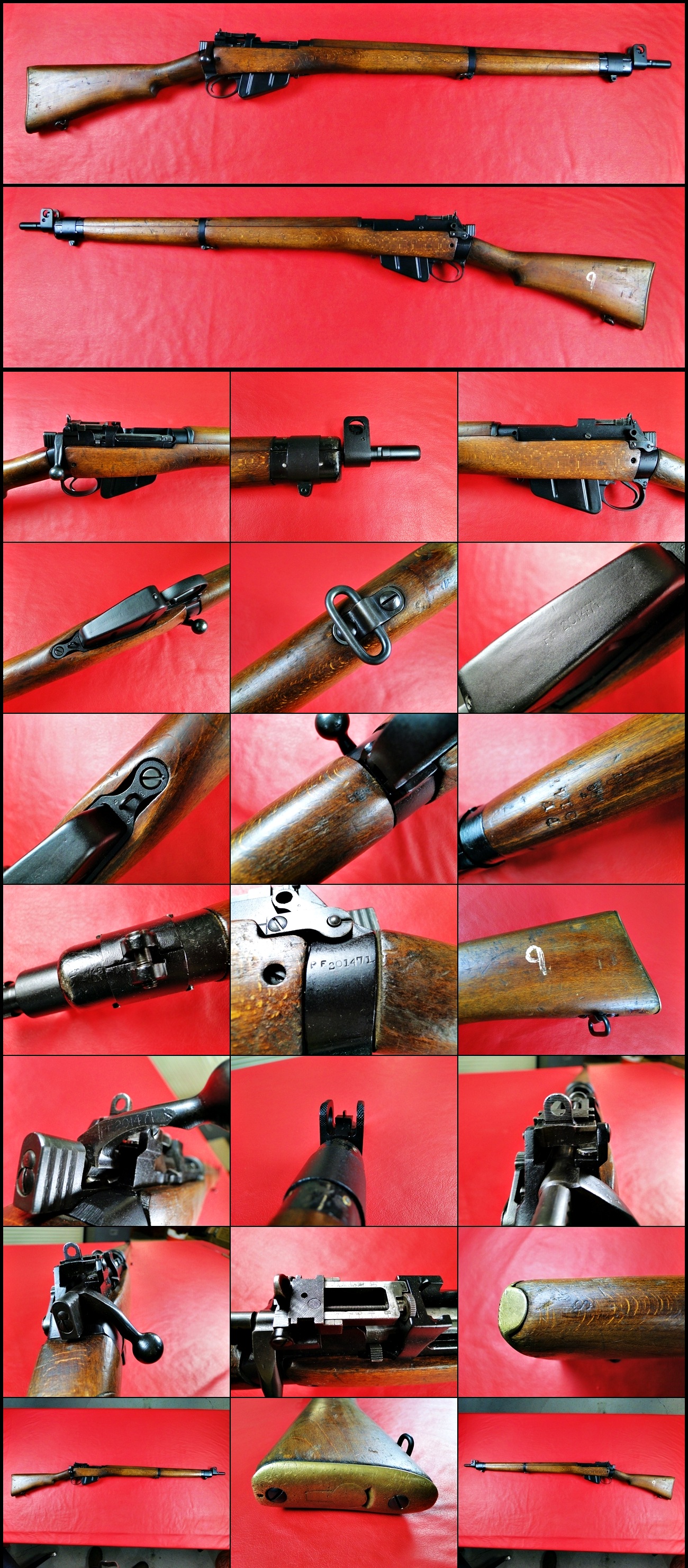
SMOF7741 - EXCELLENT NO. 4 MARK 2 RIFLE MADE AT FAZAKERY IN 1950 CALIBER 303 BRITISH. SERIAL NUMBER PF201471
The British Army adopted a magazine loaded bolt action rifle in 1888. The design came from a Scottish emigrant to the U.S., James Lee, and featured a 10 round, top loading, detachable magazine, with a bolt with rear locking lugs. It was modified after the Boer War based on the exposure to the Mauser Boers. The barrel was shortened, and a receiver bridge added for loading with stripper clips. The Lee-Enfield action continued in British (and Commonwealth) service until 1955. It is considered one of the best designed battle rifles in the world. The ten round magazine gave it an advantage over all other bolt action rifles. The rear locking lugs were much less likely to foul with dirt, and the bolt could be operated more rapidly than the standard Mauser bolt.
In 1924 the British began development of the Number 1 Mark VI rifle. Major changes to the Number 1 Mark VI rifle include moving the rear sight to the receiver bridge, changing stock fitment and furniture, and the development of a fine adjustable micrometer rear sight.
In 1931 the British changed their rifle designation nomenclature. What was formerly the Short Magazine Lee Enfield Rifle Number 1 Mark VI became known as simply as the Rifle Number 4, which was adopted by the British near the end of 1939. Production of the Number 4 rifle would begin in 1941 at Maltby, followed by Fazakerly and B.S.A Shirley. North American firms Long Branch and Savage would also produce the Number 4 rifle.
After the conclusion of World War II the British changed the design of the Number 4 rifle to reflect some of the lessons learned in the conflict. The trigger was moved from the trigger guard to the receiver socket and reinforcing bolt at the rear of the fore stock was replaced with a screw. These changes helped the rifle retain accuracy in jungle environments where humidity could cause the stock to swell and worsen trigger pull.
This rifle was produced at Fazakerly in 1950. Serial numbers on the receiver, bolt, stock, and magazine are matching. The bore is mirror bright and has strong rifling. Finish is excellent and would rate conservatively at 95%. No import mark is present. $750.00 (View Picture)
SMOF7632 - IZHEVSK MODEL 91/30 MOSIN NAGANT SERIAL NUMBER AB1589 ROMANIAN "INSTRUCTIE" CALIBER 7.62 X 54R
In 1891 Russia adopted a new rifle system primarily designed by Russian Sergei Mosin with design elements from Belgian Leon Nagant incorporated into the design. Initial production of the new 1891 rifle at the Russian arsenals of Izhevsk and Tula was slow, so contracts were granted to the French arsenal Chatellerault, and a third Russian arsenal at Sestroryetsk, in 1892. Further production of the 1891 rifle began at American firms Remington and New England Westinghouse in 1915 during the Great War.
At the outset of the Second World War Romanian was allied with France and Great Britain. When these countries could no longer guarantee the sovereignty of Romania, the government was ousted and the new establishment joined the Axis powers. As the tides of war began to turn against the Axis, Romania had a second coup d`etat, and the reestablished government returned to the Allied side. After the war Romania fell squarely in the Soviet sphere of influence.
Romania had amassed a large collection of Russian arms by the conclusion of the Second World War. Many serviceable rifles that were no longer standard issue were retained for use by second line troops or drill use. Rifles that fit this criteria were given either "Instructie" or "Exercitiu" markings, depending on the age and overall condition of the rifle.
This rifle was made at the Izhevsk arsenal in 1943. Either captured during the Second World War, or provided as military aid post war, this rifle eventually made its way into Romanian hands. During the Cold War years this rifle assigned to second line service and had the "Instructie" marking painted on the stock.
This rifle is all matching. The receiver is an undated Izhevsk. The bore is excellent with strong rifling. The finish would rate at 95% plus. No import mark is present. Instructie rifles are an uncommon variant of the Mosin Nagant rifle. This rifle is sure to please the Mosin Nagant enthusiast. $895.00 (View Picture)
SMOF7783 - 1226 EXCELLENT [SHORT, MAGAZINE LEE ENFIELD] .410 MUSKET MADE BY LITHGOW IN 1921, CONVERTED BY ISHAPORE IN 1948- NOT IMPORT MARKED
Serial number A90936 matching on receiver, bolt, forend and nose cap. Other parts not numbered. This was made as a No. 1 Mark III* .303 rifle in the late WW1 configuration without provisions for the magazine cutoff. This rifle was undoubtedly used by some English Commonwealth nation during WW2, and was in India at the time they were granted independence in August 1947. Markings on the left side of the butt socket show that in 1948 it was converted at the Rifle Factory Ishapore into a single shot ".410 Musket" (shotgun). (See Skennerton pages 367 and 473.)
The conversion was basically boring the barrel out to .410 gauge and installing a wooden block in the magazine well with a steel feed ramp on the top making the rifle a single shot shotgun. They also pinned the rear sight slide in place. The Indians used these for guards and policework. Their .410 ammunition was based on a .303 British case left straight and loaded with either a single lead ball or 12 chunks of segmented shot. (Lots of that .410 ammo has been on the surplus market at cheap prices recently, but regular .410 shotshells will not fit.)
This gun is in relatively excellent condition, unlike most of the Indian guns, and especially the shotguns which are usually badly abused, mismatched with the battered wood dripping ugly used motor pool gunk. This has about 95% of the black paint finish from time of overhaul. Wood is excellent as arsenal repaired with the marking disc hole plugged, and the buttplate tang area filled and a filler piece neatly but obviously done on the right side in the action area. Sharp TDE marking on right side of butt and various other inspection and stores markings on other wood parts. Bore is mirror bright, and good mechanics. Not import marked, so this came in prior to the 1968 requirement
This has been in John`s collection for many years but he is thinning out some of his Enfields to make room for other treasures. He kept this as the best example of the .410 Musket he ever encountered. $895.00 (View Picture)
SMOF7722 - 984 - WW2 GERMAN KAR98K 8MM MAUSER RIFLE BNZ 43 WITH SLING- NICE!
Serial number 1127 (no suffix) with 1943 date made by "bnz" (Steyer Daimler Pusch).
Matching except the stamped barrel bands which are not numbered and handguard is 1277 instead of 1127. Stock is matching serial numbered 1127 in the barrel channel.
The first rifles at the start of a new year began a new set of serial numbers with no suffix, and after each series of 0001 through 9999 was used, they added a letter suffix, so this serial number was stamped very early in the year.
However, receivers were stamped with the maker code and date much earlier in the manufacturing process. In January 1943, bnz was still using milled "H" style bands, but the bands and everything on this gun seems correct for January 1944 when stamped bands were being used. It is almost certain that that this is actually early 1944 assembly when the serial number cycle had restarted with no suffix, but some 1943 dated receivers were still being used up.
Overall an excellent rifle with about 96% original blue finish, bright and sharp bore, and correct original leather sling. Cleaning rod is missing. Far nicer than usually found these days. A really nice example of the classic WW2 German Kar98k rifle, the main arm of the Wehrmacht. $2295.00 (View Picture)
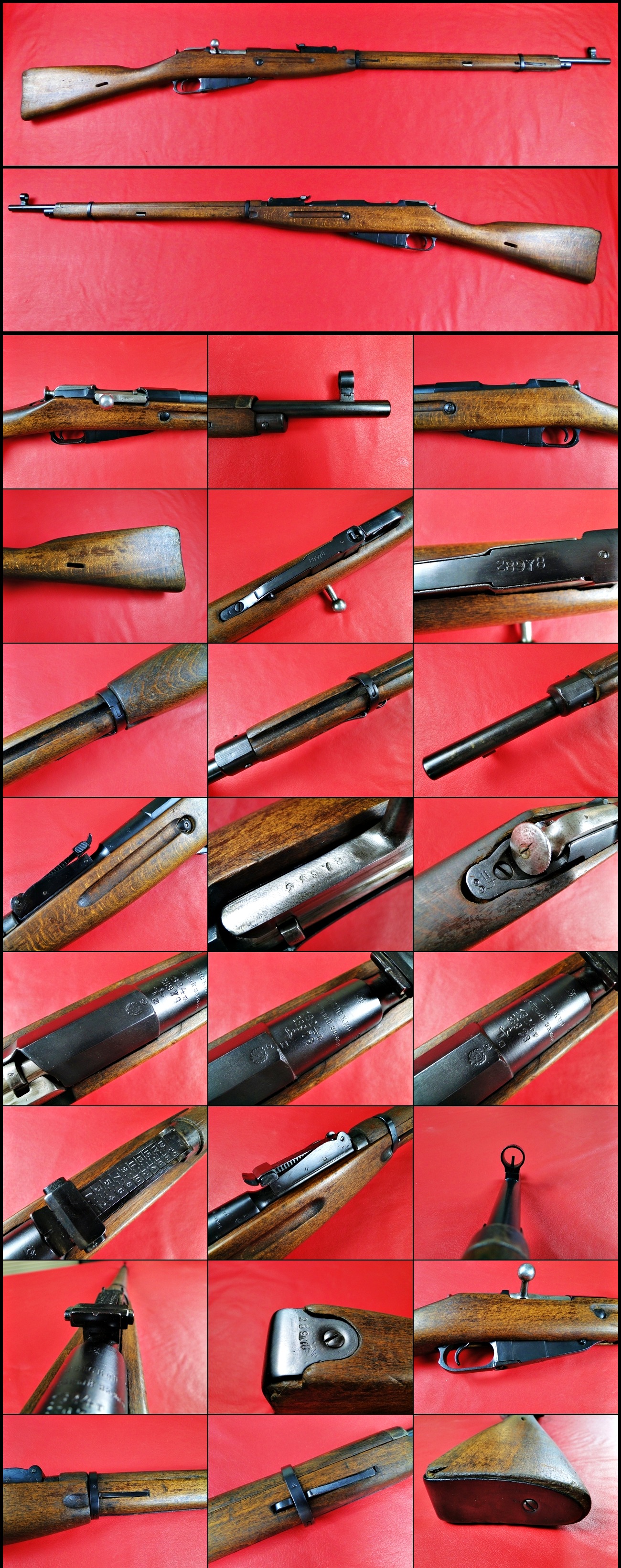
SMOF7739 - IZHEVSK MODEL 91/30 EX-DRAGOON MOSIN NAGANT SERIAL NUMBER 28978 CALIBER 7.62 X 54R
In 1891 Russia adopted a new rifle system primarily designed by Russian Sergei Mosin with design elements from Belgian Leon Nagant incorporated into the design. Initial production of the new 1891 rifle at the Russian arsenals of Izhevsk and Tula was slow, so contracts were granted to the French arsenal Chatellerault, and a third Russian arsenal at Sestroryetsk, in 1892. Further production of the 1891 rifle began at American firms Remington and New England Westinghouse in 1915 during the Great War.
Development of a shortened rifle began shortly after official adoption. In 1893 the Izhevsk arsenal began production of the dragoon model. This model included several small variations from the standard rifle. Most notably, the barrel was shortened approximately two inches. Intended for mounted infantry units, the shortened dragoon rifle was much less cumbersome than the standard 1891. In 1923 the Tula arsenal began production of the dragoon rifle. Both factories ceased production of this model in 1932.
In 1930 the Soviet government began an over haul program to update and repair rifles currently held in inventory. Old rear sights measured out in arshini were discarded in favor of new metric sights, the old front sight blade was traded for a globe and post style front sight, barrel lengths were standardized, and remnants of Imperial markings were scrubbed or defaced. Production of the hexagonal receiver was phased out in favor of a round receiver to expedite production and save materials. Modernization of the 1891 rifle was not immediate. Changes were implemented gradually, often as rifles in outdated configurations returned to arsenals for repair.
This rifle is 91/30 Ex-dragoon manufactured at Izhevsk in 1924. Barrel and receiver date are matched. All numbers are matched. The bore is bright with strong rifling. The stock has an unusual figure that is uncommon for rifles of this vintage. No import mark is present. Finish would rate above 95%. $695.00 (View Picture)
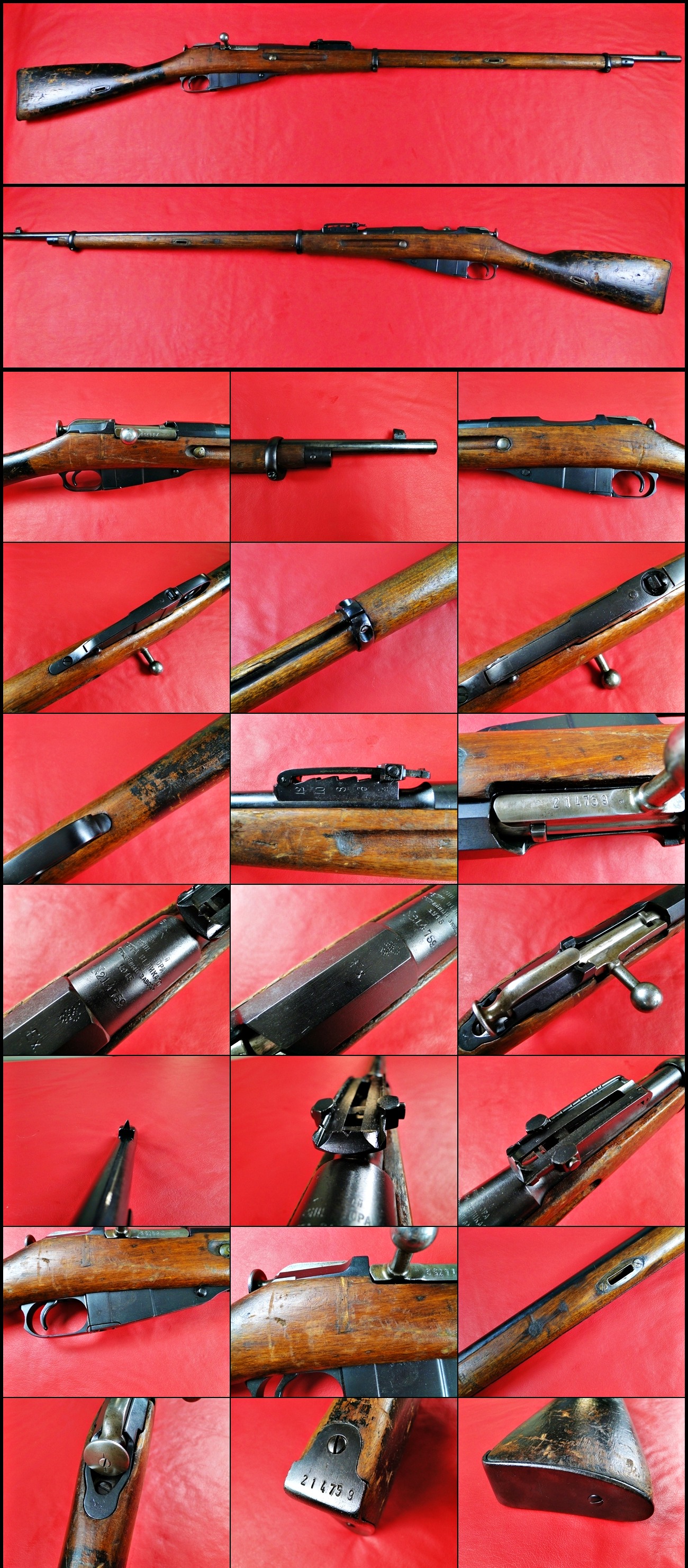
SMOF7665 - TULA MODEL 1891 MOSIN NAGANT SERIAL NUMBER N214759 ROMANIAN "EXERCITIU" CALIBER 7.62 X 54R
In 1891 Russia adopted a new rifle system primarily designed by Russian Sergei Mosin with design elements from Belgian Leon Nagant incorporated into the design. Initial production of the new 1891 rifle at the Russian arsenals of Izhevsk and Tula was slow, so contracts were granted to the French arsenal Chatellerault, and a third Russian arsenal at Sestroryetsk, in 1892. Further production of the 1891 rifle began at American firms Remington and New England Westinghouse in 1915 during the Great War.
At the outset of the Second World War Romanian was allied with France and Great Britain. When these countries could no longer guarantee the sovereignty of Romania, the government was ousted and the new establishment joined the Axis powers. As the tides of war began to turn against the Axis, Romania had a second coup d`etat, and the reestablished government returned to the Allied side. After the war Romania fell squarely in the Soviet sphere of influence.
Romania had amassed a large collection of Russian arms by the conclusion of the Second World War. Many serviceable rifles that were no longer standard issue were retained for use by second line troops or drill use. Rifles that fit this criteria were given either "Instructie" or "Exercitiu" markings, depending on the age and overall condition of the rifle.
This rifle is a model 1891 Mosin Nagant made at the Tula arsenal in 1915. It was likely provided to Romania as military aid during the First World War, where it remained in store. Imperial Russian markings have been defaced on this rifle, likely during the Second World War when Romania fought on the side of the Axis. During the Cold War this rifle was pulled from main line service and reserved for exercise use only. Black paint was applied to the butt of the rifle to signify that it was intended for training.
This rifle is all matching, including barrel and receiver date. Rifling has darkness in the grooves which may or may not clean up. Finish would rate at 95% plus. No import mark is present. This rifle is well travelled and has an interesting history that is sure to please a Mosin Nagant enthusiast. $950.00 (View Picture)
SMOF7655 - EXCELLENT NO. 4 MARK I* RIFLE MADE AT LONG BRANCH IN 1944 CALIBER 303 BRITISH. SERIAL NUMBER 71L5333
The British Army adopted a magazine loaded bolt action rifle in 1888. The design came from a Scottish emigrant to the U.S., James Lee, and featured a 10 round, top loading, detachable magazine, with a bolt with rear locking lugs. It was modified after the Boer War based on the exposure to the Mauser Boers. The barrel was shortened, and a receiver bridge added for loading with stripper clips. The Lee-Enfield action continued in British (and Commonwealth) service until 1955. It is considered one of the best designed battle rifles in the world. The ten round magazine gave it an advantage over all other bolt action rifles. The rear locking lugs were much less likely to foul with dirt, and the bolt could be operated more rapidly than the standard Mauser bolt.
In 1924 the British began development of the Number 1 Mark VI rifle. Major changes to the Number 1 Mark VI rifle include moving the rear sight to the receiver bridge, changing stock fitment and furniture, and the development of a fine adjustable micrometer rear sight.
In 1931 the British changed their rifle designation nomenclature. What was formerly the Short Magazine Lee Enfield Rifle Number 1 Mark VI became known as simply as the Rifle Number 4, which was adopted by the British near the end of 1939. Production of the Number 4 rifle would begin in 1941 at Maltby, followed by Fazakerly and B.S.A Shirley. North American firms Long Branch and Savage would also produce the Number 4 rifle.
The Long Branch arsenal was located in the Canadian province of Southern Ontario on lands owned by the Canadian government. Formerly a rifle range, military use was expanded during the First World War. In 1940 the construction of a factory was authorized, and Small Arms Limited was formed to operate the facility. Production of small arms began in 1941. Long Branch continued to produce and refurbish small arms until 1976, when the factory was closed.
This rifle was produced at the Long Branch arsenal in 1944. All numbers are matching. The majority of the small parts have the joined "LB" mark, indicating production at Long Branch. Some parts have the "S" or boxed S mark, indicating production at Savage, which is correct for this rifle. The bore is bright and has strong rifling. Finish is excellent and would rate about 95%. A British civilian export mark is present on this rifle, but there is no import mark.
From this we can gather that this rifle was produced in Canada, sent to the British for service during the Second World War, released to British civilian hands post war, and then imported in to the United States prior to 1968. $850.00 (View Picture)
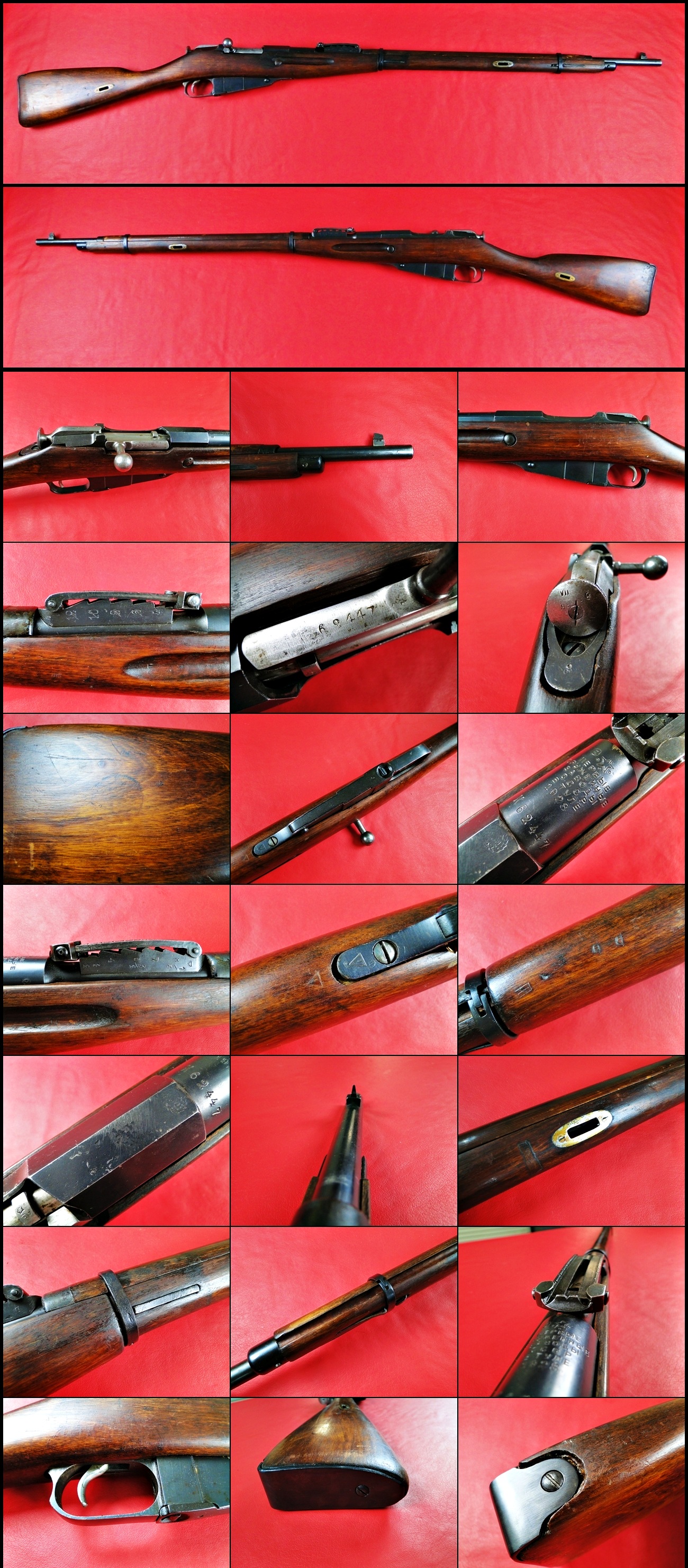
SMOF7602 - TULA MODEL 1891 DRAGOON MOSIN NAGANT SERIAL NUMBER N62447 CALIBER 7.62 X 54R
In 1891 Russia adopted a new rifle system primarily designed by Russian Sergei Mosin with design elements from Belgian Leon Nagant incorporated into the design. Initial production of the new 1891 rifle at the Russian arsenals of Izhevsk and Tula was slow, so contracts were granted to the French arsenal Chatellerault, and a third Russian arsenal at Sestroryetsk, in 1892. Further production of the 1891 rifle began at American firms Remington and New England Westinghouse in 1915 during the Great War.
Development of a shortened rifle began shortly after official adoption. In 1893 the Izhevsk arsenal began production of the dragoon model. This model included several small variations from the standard rifle. Most notably, the barrel was shortened approximately two inches. Intended for mounted infantry units, the shortened dragoon rifle was much less cumbersome than the standard 1891. In 1923 the Tula arsenal began production of the dragoon rifle. Both factories ceased production of this model in 1932.
This rifle is a model 1891 dragoon manufactured at the Tula arsenal in 1928. At some point it was captured by the Finnish, who cancelled the arshini gradations on the rear sight and applied metric measurements, as well as the "D" stamp for the D166 cartridge, on the right side. Barrel and receiver date are matched. All numbers are matched. The bore is bright with strong rifling, but has been counter bored. No import mark is present. Finish would rate above 90%, with most wear present on the high sports of the receiver.
Dragoon rifles that escaped the 91/30 update are an uncommon sight, especially as the production date gets closer to 1930. This rifle is an interesting specimen sure to please the avid Mosin Nagant collector. $950.00 (View Picture)
SMOF7684 - SWISS M1896/1911 SCHMIDT-RUBIN STRAIGHT PULL RIFLE IN 7.5MM SWISS CALIBER MADE AT WAFFENFABRIK BERN IN 1910 (NICE!)
Serial number 338147, matching, complete with correct muzzle cover. Excellent mirror bright bore. A great representative example of the straight pull rifles used by Switzerland from 1889 to 1958.
Around 1885 the idea of a straight pull action gained popularity among military designers. Mannlicher came up with a design use by Austria-Hungary circa 1885-1895, and James Paris Lee came up with the 6mm Winchester-Lee Navy rifles used by the U.S. Navy circa 1895-1903. Switzerland adopted a straight pull invented by Schmidt and Rubin in 1889.
The Model 1889 design experienced problems with the new 7.5mm rimless, smokeless powder cartridge, and in 1896 a redesigned bolt was adopted, and about 127,000 Model 18986 rifles were made at Waffenfabrik Bern between 1897 and 1912, and many of the earlier Model 1889s rifles were updated.
A new version was adopted in 1911 with four groove rifling, chambered for the Ordonnanz 11 cartridge, a pistol grip stock, and modified magazine and trigger guard designs, and a flat buttplate. While production proceeded on new Model 1911 rifles, about 135,000 of the Model 1896 and Model 1889/96 rifles were updated to become "Model 1896/1911" like this one. They are functionally identical to the M1911, but the rounded buttplate, added pistol grip, and traces of the earlier style magazine make them visually a tiny bit different.
Eventually, the Model 1931 was adopted, basically the same as the Model 1911 except shortened in overall length to fit the post-WW1 desire for better handling qualities and reduced weights in military rifles. The M1931 remained in production until 1958 when replaced by "assault rifle" models.
Switzerland`s army is made up of a small active force, mainly reservists undergoing training and a massive reserve force consisting of virtually every able bodied male. Every man is given his rifle upon completion of their initial training, to be taken home along with a sealed supply of ammunition to be available instantly upon mobilization. Of course, they are encouraged to engage in rifle practice and competition, using locally purchased or supplied ammunition. Reportedly many of these rifles sometimes have a slip of paper with the soldier`s name under the buttplate, although we checked and this one does not have any ID there. This rifle is an excellent example of a well thought out design, manufactured with the quality and precision one would expect of a nation famous for its watch making, and well cared for as if it were the individual`s own property. About 96-97% original blue finish remains, with a few surface rust freckles that should clean off. The unsanded stock has its original oil finish, with good inspector markings and added local number 131907 added on the top of the butt. Two or three small scrapes/gouges on the stock by the right forend grasping grooves, but otherwise just minor storage and use marks expected of a 100+ year old military rifle. The often broken grasping knobs on the bolt handle are replacements. Comes with the correct brass muzzle cover. A really nice example of this historically significant design. $650.00 (View Picture)
SMOF7619 - MATCHING 91/30 MOSIN NAGANT TULA 1936 SERIAL NUMBER 17685 CALIBER 7.62 X 54R ROMANIAN CAPTURE
In 1891 Russia adopted a new rifle system primarily designed by Russian Sergei Mosin with design elements from Belgian Leon Nagant incorporated into the design. Initial production of the new 1891 rifle at the Russian arsenals of Izhevsk and Tula was slow, so contracts were granted to the French arsenal Chatellerault, and a third Russian arsenal at Sestroryetsk, in 1892. Further production of the 1891 rifle began at American firms Remington and New England Westinghouse in 1915 during the Great War.
In 1930 the Soviet government began an over haul program to update and repair rifles currently held in inventory. Old rear sights measured out in arshini were discarded in favor of new metric sights, the old front sight blade was traded for a globe and post style front sight, barrel lengths were standardized, and remnants of Imperial markings were scrubbed or defaced. Production of the hexagonal receiver was phased out in favor of a round receiver to expedite production and save materials. Modernization of the 1891 rifle was not immediate. Changes were implemented gradually, often as rifles in outdated configurations returned to arsenals for repair.
This rifle would appear to the untrained eye to be a typical 91/30, but to the discerning collector several features are present that reveal an interesting history. The receiver and barrel have a triangle with number marking and the stock has a splice just rear of the front sling escutcheon. These are features typical features for a Romanian captured rifle.
At the outset of the war Romanian was allied with France and Great Britain. When these countries could no longer guarantee the sovereignty of Romanian, the government was ousted and the new establishment joined the Axis powers. As the tides of war began to turn against the Axis, Romania had a second coup d`etat, and the reestablished government returned to the Allied side. After the war Romania fell squarely in the Soviet sphere of influence.
This rifle was made at the Tula arsenal in 1936. It has a hex receiver, which has a matching date to the barrel. All numbers are matching. The bore has good rifling but the grooves are slightly dark, which may or may not clean up. No import mark is present. $750.00 (View Picture)
SMOF7574 - WW2 JAPANESE TYPE 97 6.5MM SNIPER RIFLE BY NAGOYA SERIES 1 WITH 2.5X SCOPE - MUM RESTORED
Serial number 10707 on left side of receiver, preceded by Series 1 symbol. Matching 707 on bolt, bolt guts, and upper band. At first glance the mum appears intact, but close scrutiny shows that it was ground, and the damaged area built up by welding and the mum reapplied. Receiver ring has the original 97 type markings.
These Type 97 sniper rifles are basically the Type 38 infantry rifle with 31.25 inch barrels with the addition of a mounting bracket for a scope on the left side of the receiver and use of a special bolt with the handle made extra long and bent for scope clearance. Around 22,000 Type 97 snipers were made. About 11,000 of the 7.7mm Type 99 rifles had a similar sniper modifications, but the Type 97 snipers saw far more use. Either of the Japanese sniper rifles are prized additions to any WW2 military collections, thoses with intact mums are especially desirable. Matching scopes are a huge plus, but there seem to be only about 250 matched rifle/scope combinations surviving, and only about 16 of those have intact mums. So, while the mum on this one is restored, and the scope mismatched, it is still about as good as most collector will be able to find.
This is a good example of the Type 97 sniper chambered in 6.5 x 50mm. Most of these are found in really worn out condition; this particular one has most of its original blue finish, and touched up where the mum was restored. Some scattered light rust freckles and beginning to turn plum, and worn on the buttplate Stock has sharp contours, and sharp inspector marks. Never sanded, it has the original finish showing field use with assorted dings and scars, nothing major, but typical evidence of combat use. a very few minor blemishes to the wood. Bore is good, but needs a good cleaning.
Scope is the 2.5 x 10 degree type, serial number 10352 marked for Nagoya made rifle series 1 serial number 9667. Good optics with a few specks of paint/crud on the reticule lens. About 95% of the black paint finish remains, and it has the original rubber eyepiece. No case for the scope. Scopes were individually fitted, and this fits pretty well, but requires a slight tap to remove after moving the release lever to the forward (LOOSE) position, and depressing the catch spring. $4595.00 (View Picture)
SMOF4629 - 14293 BRITISH "DRILL PURPOSE" PATTERN 1914 .303 CALIBER RIFLE BY WINCHESTER
Serial number 51684 with matching number on bolt. Other parts appear to be typical mix of makers including the "fat boy" Eddystone stock. Drill purpose rifles were made from obsolete patterns to provide non-lethal arms to be used by recruits or cadets learning the manual of arms, close order drill, punishment marching, etc where a current service rifle was not needed, but something with the approximate weight and feel was desired. This would be an interesting collecting niche, with the goal of including the many different "Drill Purpose` arms from the British, the US Navy Mark I Training rifle made by Parris Dunn and the Mark V dummy drill rifle, , the M16 "Rubber Duck` and the CMP M1903 and M1 drill rifles. The Pattern 1914 DP rifles were converted by drilling a hole laterally through the chamber (and adjacent stock and handguard) and welding a steel rod in place, painting a red and white stripe around the action area, and stamping DP on just about every part. These rifles had seen hard use prior to conversion and usually show numerous stock repairs, as well as dings and bruises acquired throughout their career aggravated by clumsy handling by awkward recruits intimidated by screaming sergeants. A number of these came into the US in the 1980s or 90s, and sold for ridiculously low prices at the time, with most of them snatched up and stripped down for their actions to make sporters. This has left surviving examples rather scarce. A great addition for a British collection, or for the P1914/M1917 addict, or someone interested in "drill rifles`. Overall condition is VG. The wood continues to weep a bit of the heavy grease they were packed in for storage, although we cleaned all we could. Even though incapable of firing with the drilled and plugged chamber, this still is considered a "firearm` and must go to a FFL or C&R FFL. $395.00 (View Picture)
SMOF7673 - 636 RUSSIAN MOSIN NAGANT MODEL 91/30 RIFLE MADE BY IZHEVSK IN 1936 7.62 X 54MMR -MINTY!
Serial number 26935 matching, with Century Arms, Georgia, VT import marks on left side of receiver with their serial number 9130006552. Appears to be about mint unissued, but I believe these are actually rifles that were overhauled (in Ukraine?) to as new condition post WW2, and left in reserve until deemed obsolete and sold off in the 1980s. Bore VG or better although some darkness in the grooves, but might just need a good cleaning. This has the typical light colored stock with a varnish type finish, marked with a square with diagonal line on the right side of the butt. Metal finish about 99% intact. Several minor bumps and bruises on the right side near the lower band, but nothing major. Comes with correct web sling with "dog collar" attaching loops. An excellent example of the main Russian rifle of WW2. Variations of these were later made and used by most of the evil empire countries well until the late 20th century, even though largely replaced by the ubiquitous AK-47 for first line troops. This is one of the nicest examples we have seen in a long time. $625.00 (View Picture)
SMOF7676 - 633 YUGOSLAVIAN M48 8MM MAUSER RIFLE WITH S&K SCOPE MOUNT AND 3X9 VARIABLE SCOPE- SUPERB BORE- SLIGHTLY BOOGERED
Serial number M99073, matching on the numbered parts. Made by Preduzece 44 (Kragujevac Arsenal) in 1952. All in about new condition with 99% arsenal blue finish. Bore is excellent- bright and sharp.
Scope and mounts are in similar like new condition. All matching numbers. Crisp stock cartouches and nearly unblemished wood. However, Bubba decided he wanted a scope on his Bambi blaster, so he had the bolt handle modified to Winchester Model 70 configuration (a nice job) for scope clearance. He did NOT drill and tap anything, but got a S&K Insta Mount which uses split rings which camp onto the rounded receiver. So, while the metal is not disturbed, small areas of the stock have to be cut away for the lower part of the scope mount. Bubba is no craftsman, and the notches are not quite aligned, foring the mount a little out of alignment, but a little easy chisel/file work will fix that up. The Scope is a 3-9 power variable Center Point with 40mm objective lens. These are inexpensive scopes, but get the job done. We had to remove the scope and mounts to verify the serial number, and have left them off so the buyer can (a) verify the serial number, (b) decide if they want to reinstall the scope mount, and if so (c) get the notches corrected, or (d) sell the scope and mount.
Prior to WW2 Yugoslavia had purchased a number of Model 1924 Mauser short rifles and a full set of machinery to make them from FN in Belgium. Then they made more rifles in their own Kragujevac Arsenal, later known as Factory 44 (PREDUZECE 44). The Model 1924 rifles had an "intermediate length" action about 1/4 inch shorter than the standard Model 98 Mauser actions used in the Gew 98 and K98 series rifles, but were otherwise very similar to the K98k and all used the standard 7.92 x 57mm ammunition popularly called 8mm Mauser in the U.S.
During the post- WW2 rearming of Yugoslavian forces under Marshall Tito and the Communists virtually all old Mauser rifles on hand (including various Model 1924 and Model 98 and Kar98k types on hand) were refurbished, and remarked with the communist crest (two sheaves of wheat bordering a torch, with the commie star above) and given new model designations.
While reworking older rifles, the Yugos also adopted a design for newly made rifles based on the 1924 action and K98k style stocks, and the Model 48 was produced 1950-1953. A simplified stamped floorplate version designated the Model 48A, was made 1953-56. Further improvements in stamping resulted in a stamped trigger guard assembly (with detachable stamped floorplate) designated the Model 48B, made only in 1957, although retaining the M48A designation on the receiver ring.
This is just one of many interesting variants of the classic 98 Mauser family made by the Yugoslavians. Collecting Yugoslavian Mauser variations would be a fun and inexpensive specialty. See the comprehensive "Serbian and Yugoslav Mauser Rifles" by Branko Bogdanovic, devoted exclusively to all the Yugo rifle types.
What you see is what you get, a really nice M48 Yugo Mauser, with bolt handle altered, and the scope and mount. All for only $595.00 (View Picture)
SMOF7589 - 426 - SCARCE RUSSIAN MODEL 1891/30 MOSIN NAGANT EX- PU SNIPER RIFLE REFURBISHED AS STANDARD INFANTRY RIFLE 7.62 X 54MMR
Serial number assigned by importer C.A.I is 9130403967, and BATF requires using that on record keeping. Original serial number is KT363 when made at Izhevsk in 1943 as a PU sniper rifle, and probably used against the Germans in WW2. Excellent plus arsenal refurbished with 99% finish remaining on the metal and the wood has about 98% of the shellac(?) finish. Still has some storage grease in recesses. This was made with a PU scope on the left side of the receiver as seen on the 91/30 Russian sniper rifles on the market (real and fake). This has the distinguishing markings found on the real sniper rifles, including the scope serial number 34821 on the left side of the barrel shank, lined out. Nearby is the "sniper grade barrel" mark of a C in a circle. The right side of the barrel has the (poorly stamped) circle within a circle found on most Izhevsk Russian snipers. The key identifying features are the four holes for attaching the scope mount visible on the inside of the receiver, and welded over on the outside then crudely ground before being refinished during refurb. The left side of the stock has a wooden patch where it was originally cut for the scope mount, bringing it back to standard rifle configuration. (There is another stock patch by the upper band,) The bolt installed during refurb has the infantry short straight handle, not the long bent handle of snipers. Matching serial number 363 on the bolt, floorplate and buttplate, the only numbered parts other than the barrel shank. Century import marks on left side of receiver. Good bore, dark in grooves but will probably clean up some.
It would be easy to redrill the plugged holes and install a cheap repro scope and mount, but that destroys the history of an "evolved" rifle which saw service and then was modified by the Russian military into its present configuration. Some people will do all sorts of molestations to "restore" things, like the beautiful flintlock Kentucky rifle with tiger maple stock, handsome patchbox and silver inlays, all restored to original from a single buttplate screw someone found. Don`t be a Bubba! As one of the Russian rifle forums says "Leave them as ex-snipers. Remember, no collectors collect ex- snipers that have been re-snipered."
A really great example of a genuine WW2 Russian PU sniper rifle which undoubtedly saw combat and was then overhauled and converted to standard infantry configuration and held in Cold War reserve stocks, a nice historical background. These "ex-sniper" rifles are actually pretty scarce. This is the only one I have seen in person, compared to hundreds of Mosin snipers with scopes, some real, but most parts jobs. A treasure for a serious Mosin Nagant collector. $750.00 (View Picture)
SMOF5310 - 18435 - VERY UNUSUAL- CRUDE KHYBER PASS COPY OF BRITISH ENFIELD NO. 5 MARK I `JUNGLE CARBINE` -
From a few feet away this looks like a standard British No. 5 Mark 1 .303 `Jungle Carbine.` However, closer inspection show that it is a crude hand made copy turned out in the `Khyber Pass` region of Pakistan/Afghanistan. These talented craftsmen make copies of an amazing variety of guns using whatever materials they can find, almost entirely by hand. The quality ranges from very good to laughably poor in appearance, but the quality of the materials and heat treatment (if any) and the tolerances make them all UNSAFE TO FIRE UNDER ANY CONDITIONS. While the locals do sometimes fire these things, they do so with reloaded ammunition, the bullets sometimes recovered from rifle ranges with the rifling marks filed off, and powder of varying quality. Most of these people are illiterate, so the markings (if any) are very creative in spelling, punctuation, and inexplicably mix stuff so you might find Broowneng Patant, and the crown/V.R. from the reign of Queen Victoria on a gun that is a mongrel mix of broomhandle Mauser and Astra features. Today their specialty is making copies of pre-1898 British arms for sale to American troops who can bring home `antique` guns but not modern guns. [See our main page for more on those...]
This `Jungle Carbine` is one of a handful that Century Arms found among the stuff they imported in the 1980s, and was sold via Springfield Sporters in Pennsylvania. They had the wisdom to cut off the firing pin and weld the firing pin hole shut so that no one can fire it. The bolt they used was made by Savage (square S on the back of the handle and old number removed). Or, perhaps the makers used this one, as it has been extensively filed so that it will fit the receiver and then refinished. The receiver shows all sorts of crude details, but is a faithful copy of the real Jungle Carbine. Similarly, the other parts show many crude features, and probably not a single part would interchange with a real Lee Enfield. The barrel and receiver have a nicely polished and blued finish of unknown age. The barrel may have been salvaged from a `real` Enfield, or at least the rifling looks well done (albeit rusty and rough) or they may have just gotten good at rifling barrels after many decades of practice. The stock is not too badly done, but the butt swivel is a non-regulation feature, and the recoil pad was probably cut from someone`s truck tire (with or without their knowledge!).
This is the perfect addition to an `Enfield` collection that has everything else. NOT SAFE TO FIRE, but we still need to transfer it to a FFL. $625.00 (View Picture)
SMOF5793 - 22120 - JAPANESE TYPE 38 TRAINING RIFLE (BLANKS ONLY)
- Serial number- none- maker unknown Japanese factory. These are pretty scarce compared to `regular` Type 38 rifles, and this is the only one we have seen that includes a bolt cover. Will look better cleaned up. An interesting addition to any WW2 or Japanese weapon collection.
Although some Japanese training rifles were damaged or obsolete arms slightly modified for training use, many, like this one, were purpose made using very crude materials totally unsafe for ever firing with live ammunition. These use cast iron for receivers and other parts were crudely fashioned and ill-fitting, but good enough for youngsters to practice drill. These were also used to fire blank cartridges (and those made from `real` guns were specifically marked to be used with blanks only). The bores on these barrels are simple smoothbore holes either crudely drilled of even cast, and the locking lugs on the bolt are more decorative than functional. The `cleaning rod` is a dummy part just stuck into the stock tip.
This is a good example of these somewhat scarce Japanese military arms with the typical one piece stock (instead of the usual use of a separate piece of wood for the lower part of the Buttstock) which is unsanded and has the original finish and an old rack number 82 painted on the right side. This one is a bit unusual in having a crudely made bolt cover. The rear sight sleeve is very loose on the barrel, and just about every part you look at is decidedly non-standard and `cheap Jap junk` quality.
Metal parts were originally finished some dark color, perhaps by bluing or some other process but that has turned mostly to light brown patina, but it may clean up with some patient work with some oil and steel wool.
Remember, this is NOT TO BE FIRED. $225.00 (View Picture)
Restoration Projects
SMOF7942 - FRENCH MANNLICHER-BERTHIER MODEL 1916 BARRELED RECEIVER IN 8 X 50MMR LEBEL CALIBER.
Barrel cut to 18 inches and sporter style ramp front sight added. Decent but dirty bore, it may or may not clean up. Lots of blue finish. What you see is what you get. Since this includes a receiver it has to go to a FFL holder. $75.00 (View Picture)
SMOF8054 - 2797 - CUSTOM SPORTING RIFLE- LARGE RING MAUSER IN .30-06 WITH FLUTED BARREL AND 2.5-10X 40MM SCOPE
Serial number 6288. Built on a Czech made VZ- 24 action by a highly skilled gunsmith, but we do not know the name, as this is an estate gun which came with limited information. The bolt has been modified to the classic Winchester Model 70 style handle for good looks and ease of operation, and the safety is also a Model 70 style The bolt body is beautifully polished and a tight engine turned or "jeweled" pattern with the rest of the bolt in a dull blue finish. Trigger is a high grade commercial trigger, not the every day Timney or Canjar, but something much nicer although we cannot identify the maker. The 25 inch barrel is heavy weight measuring 1.15"diameter at the breech tapering to .875" at the muzzle, and the actual weight is reduced by six flutes, which also add rigidity for better accuracy. Weight of the rifle (less scope) is 9 pounds, 10 ounces. Muzzle has a recessed crown. Barrel and receiver had a matte gray finish, probably some sort of phosphate. The fiberglass (possibly carbon fiber?) stock is an attractive classic sporter profile with woodland camouflage pattern finish and Pachmayr Decelerator recoil pad. It comes with a Redfield Junior scope mount base and a Bushnell Elite series 2.5 to 10x variable scope with 40mm objective lens, and rings. Scope is covered by a lifetime warranty for any owner, and comes with the original box. Overall the rifle appears to be almost unfired and near new condition except for one small scrape on the barrel finish about 5" from the muzzle. Replacement cost if you ordered one like this today would probably be at least double our price. This is not Bubba`s basement butchery, but a fine custom rifle from a skilled craftsman. $950.00 (View Picture)
SMOF7964 - 2161 - SCARCE SHORT LEE ENFIELD MARK I*** .303 RIFLE MADE BY BIRMINGHAM SMALL ARMS IN 1906 (RESTORATION PROJECT)
Serial number ER 7809 over canceled 86897. Adopted in 1903, the "Short, Magazine. Lee Enfield Mark I" broke the tradition of having long rifles for infantry and short carbines for mounted troops and henceforth everyone would use the same intermediate length "short" rifle. These retained the same action as the "Long" Lee (and Metford) rifles, and used the same Mark VI cartridges with a heavy round nose bullet. However, the new rifles were full stocked and introduced the bulky but sturdy nose cap used on the later WW1 No. 1 Mark III/III* rifles. Recognizing the advantage of Mauser stripper clip loading, they included a fixed guide on the left side of the receiver, and a sliding guide on the top of the bolt head so when the bolt was back, it lined up and stripper clips could be used. Like most military programs in peacetime and constrained budgets, various minor changes were introduced piecemeal and overlapping between 1903 adoption of the Short Lee Enfield and the 1914 start of WW1. In 1907 the lighter weight spitzer bullet cartridge Mark VII was adopted, requiring modification of sights, and other minor changes.
Meanwhile, the No. 1 Mark III was being adopted about 1907 with a fixed bridge style stripper clip guide and other minor changes, even while contracts for the Mark I* remained in effect. In 1913 they adopted for trials the Mauser style Pattern 1913 in a new .276 rimless cartridge, which was quickly modified to the .303 caliber pattern 1914 rifle. Starting about 1914, the Brits got busy converting the early Mark I rifle to use the new Mark VII ammunition, and making any needed repairs, sometimes with newer parts, but restricted issue to certain categories of troops. Post WW1 the outdated Mark I (and *, ** and *** variant) series rifles went thru a quick clean and repair operation and were placed in storage.
In early 1923 the Brits sent about 10,000 rifles to the newly formed Irish Free State, engaged in the perpetual "troubles" among various factions over religion, governance, royalty, and genetic clover monkey pugnacity. These rifles had their original serial numbers struck through, and new ER prefixed serial numbers applied to barrel, receiver and bolt, for Irish record keeping. These remained in service until the 1950s, and in the early 1960s Sam Cummings` Interarmco "Ye Olde Hunter" outfit brought 4,105 of the Mark I*** rifles from Ireland to the U.S. Another batch had "CR" prefixes and are probably from a circa 1930 shipment to Ireland, and these show have Mark III style sights (lacking windage adjustment) and stocks with the Mark III sight protector fastened to the forend, not the handguard.
Forgotton Weapons did a good video on these at https://www.youtube.com/watch?v=72j36oCeD6c
and there is a lengthy forum discussion on the Mark I*** at https://www.gunboards.com/threads/lee- enfield-mark-i-questions.170768/
Ye Olde Hunter apparently "sporterized" quite a few of the Mark I*** rifles they imported to appeal to the deer hunter market, as there really were not many military surplus rifle collectors then, and they had mountains of .303 rifles to sell. The front sight is not modified, and the ramp is a stamped sheet metal part that is easily removed when the front sight blade is drifted out. The butt stock is unmodified, other than having the marking disc removed and filled. The screws for the butt swivel are incorrect replacements. The rear volley sight remains intact. Good bore. One sporterized nearly identical to this, but with the rare sliding charger guide removed and some chrome plated parts recently sold on GunBroker for $410.00. One of the CR prefix guns with the Mark III style sights and NOT sporterized sold on GunBroker (item 1073915991) for $2,500.00
This is an important milestone in the Lee Enfield story, and well worth the effort to restore it to more original configuration. The easiest and cheapest way would be to use No. 1 Mark III forend stock and furniture, although it originally had the earlier rear sight protector on the handguard, not the forend. Prestigious Wood Stocks (located in Canada, but no problems shipping to the U.S.) has very high quality reproduction stocks available for this specific model, and many other arms: https://www.prestigiouswoodstocks.com/products/lee-enfield-no-1-mk-l-lower-forestock
It would be nice to see this one restored, and in its present condition it is a bargain at only $550.00 (View Picture)
SMOF7800 - HANSOME BELGIAN BROWNING BAR CALIBER 270 WIN GRADE II SERIAL NUMBER 94112M69 BELGAIN MADE
In 1967 Browning introduced the Browning Automatic Rifle, commonly referred to as the BAR. Initially offered in .243 Win, .270 Win, .308 Win, and .30-06, the BAR was intended to be a direct competitor to the semi-automatic rifles offered by Winchester and Remington. In 1969 7MM Rem Mag, 300 Win Mag, and 338 Win Mag were also offered in a magnum version.
Browning also offered different grades in the BAR. As the grades increased so did the quality of the wood selected for the stocks. Grade I was considered the standard rifle and featured no engraving. Grade II featured a scroll type engraving with an elk and a buck engraved on the receiver. Grade III featured a more complicated checkering pattern on the stocks, and an elaborate scrollwork scene featuring a bugling elk was included on the receiver. Grade IV deleted the presence of iron sights to make the rifle more svelte, the stocks received hand engraved oak leave patterns in addition to a finer line per inch pattern, and the receiver was engraved with an outdoor scene. The Grade V had all of the features of the previous grade, but also received gold in lay on various parts of the rifle, including the engraving.
In 1977 Browning moved assembly of the BAR to a facility in Portugal. Most collectors consider the Belgian produced BAR rifles to be the finest quality and the most desirable.
This rifle is a Grade II BAR produced in Belgium in 1969. Overall condition is excellent, with original bluing rating at about 95%+. The stock is in above average condition, with one small area on the fore stock near the receiver showing bruising. Bore is mirror bright and would rate near mint. A Leupold style base is included with the rifle. ------------------------------------------------- $1250.00 (View Picture)
SMOF7327 - FRANCHI SEMI-AUTO 12 GAUGE 3-INCH MODEL 48AM WITH 32 INCH VENT RIB BARREL
Serial number 147617 with 32 inch vented rib, full choke barrel for serious hunting use. Mechanically, this is a copy of the rugged and reliable Browning Auto-5 design, with slight cosmetic updates which make it more attractive and modern looking. Made in Brescia, Italy in 1970, this is a really handsome gun, with high polish blue finish, handsome walnut stock with really nice checkering and a good recoil pad. Reportedly these are quite happy to use with steel shot.
There is a similar Model 48 AL which is a much lighter weight gun with shorter barrel and aluminum receiver, but this is the heavier gun better suited for the 3" 12 gauge shells needed for waterfowl. The best part is that it has been used just a tiny bit, so you will not feel guilty taking it out and adding an occasional scratch or rust spot on it. There are two small rust spots on the left side of the receiver, one on the right and a couple on the barrel above the end of the forend. You might be able to clean those off, or make them look a lot worse, so we would probably just leave them alone as a reminder to always oil your guns when putting them away, and don`t leave them in a cloth case. A couple of insignificant scratches are on the butt such as eventually appear on all hunting guns. We sell all guns as collector items to be approved by a competent gunsmith prior to firing, but we know of no reason this would not be approved. This was made in 1970, and now qualifies as a `Curio or relic" under the 50 year rule, and can be shipped to a C&R FFL. A really nice gun by a respected maker, at a very affordable price and C&R eligible! $495.00 (View Picture)